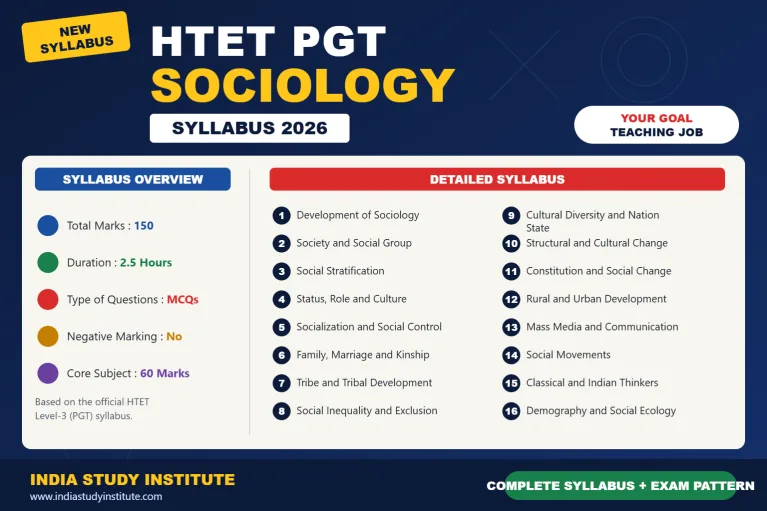
HTET PGT Sociology Syllabus 2026
Sociology rewards candidates who can hold theory and context together. Basic concepts and sociological thought supply the framework; Indian society and social change supply the material it has to explain. Questions tend to test the join between them rather than either in isolation.
This guide sets out the official Board syllabus in full, along with the ninety marks of common papers shared with every other Level-3 subject and the exam pattern notified for 2026.
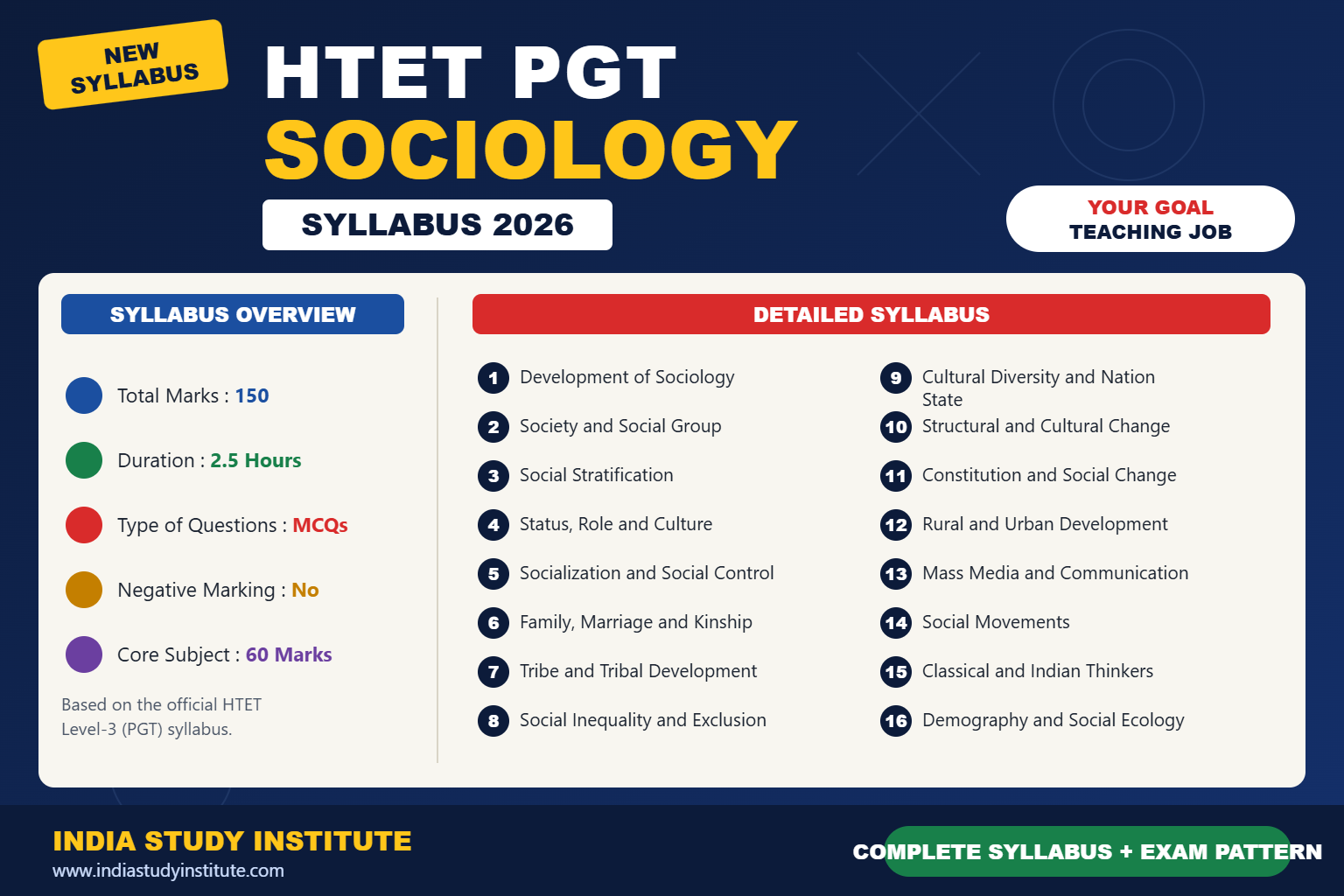
HTET PGT Sociology Exam Pattern
Before the topics, get the structure straight. The paper is 150 multiple choice questions worth 150 marks, to be attempted in 2.5 hours. There is no negative marking, so leaving a question blank costs you the same as getting it wrong - attempt everything.
- Child Development and Pedagogy: 30 questions / 30 marks
- Languages (Hindi 15 and English 15): 30 questions / 30 marks
- General Studies (Quantitative Aptitude, Reasoning, Haryana GK): 30 questions / 30 marks
- Core Subject - Sociology: 60 questions / 60 marks
- Total: 150 questions / 150 marks / 2.5 hours / no negative marking
Keep this HTET PGT Sociology Syllabus 2026 breakdown open while you build your study plan. All of the following is reproduced from the Board's published syllabus.
Part I: Common Subjects (90 Marks)
Every HTET Level-3 candidate answers the same 90 marks of common papers, whatever their teaching subject. Marks lost in this block are the hardest to recover elsewhere.
1. Child Development and Pedagogy (30 Marks)
This section tests your understanding of educational psychology as it applies to teaching senior secondary students.
- Child Development: Concept of development and its relationship with learning; principles of the development of children; influence of heredity and environment; socialization processes involving teachers, parents and peers.
- Key Theories: Piaget, Kohlberg and Vygotsky - constructs and critical perspectives; Freud's psychosexual development theory; Erikson's theory of psychosocial development; Bandura's social learning theory.
- Concepts and Intelligence: Child-centred and progressive education; critical perspective on the construct of intelligence; multi-dimensional intelligence; language and thought; gender as a social construct, gender roles and educational practice.
- Individual Differences: Understanding differences based on diversity of language, caste, gender, community and religion.
- Assessment: Distinction between assessment for learning and assessment of learning; school-based assessment; Continuous and Comprehensive Evaluation; formulating appropriate questions to assess readiness levels, enhance learning and critical thinking, and measure learner achievement.
- Inclusive Education: Understanding children with special needs; addressing learners from diverse, disadvantaged and deprived backgrounds; addressing children with learning difficulties and impairments; addressing talented, creative and specially abled learners.
- Learning and Pedagogy: How children think and learn, and why they sometimes fail to succeed in school; basic processes of teaching and learning; children's strategies of learning; learning as a social activity; the child as a problem solver and scientific investigator; understanding children's errors as significant steps in learning; cognition and emotions; motivation and learning; personal and environmental factors contributing to learning.
2. Languages (30 Marks)
The language paper is split evenly between Hindi and English, 15 marks each.
- Hindi (15 Marks): Reading an unseen passage from prose, drama or poetry with questions on comprehension, inference, grammar and verbal ability. Pedagogy of language development covering learning and acquisition, principles of language teaching, the role of listening and speaking, a critical perspective on the role of grammar, challenges of teaching language in a diverse classroom, language difficulties, errors and disorders, and teaching-learning materials.
- English (15 Marks): One unseen prose passage (discursive, literary, narrative or scientific) with questions on comprehension, grammar and verbal ability. Pedagogy of language development covering the same set of principles, plus textbooks, multi-media materials and multilingual resources of the classroom.
3. General Studies (30 Marks)
A composite section of three equal parts, testing aptitude, reasoning and state awareness.
- Quantitative Aptitude (10 Marks): Whole numbers, fractions and decimals, percentages, profit and loss, ratio and proportion, time and work, averages, basic algebra, geometry of triangles and circles, basic trigonometry, and interpretation of data graphs such as pie charts and histograms.
- Reasoning Ability (10 Marks): Verbal and non-verbal reasoning, analogies, space visualization, coding and decoding, syllogisms, Venn diagrams, pattern folding and unfolding, embedded figures, and social and emotional intelligence.
- Haryana General Knowledge and Awareness (10 Marks): State history, geography, civics, environment, regional culture, arts and traditions, current affairs, and active state welfare schemes.
Part II: Core Subject - Sociology (60 Marks)
Questions are based on topics from the Class 9 to 12 syllabus prescribed by the Education Department of Haryana. The difficulty level, however, extends up to the post-graduate standard, so expect familiar topics to be tested at a much deeper conceptual level.
Part 1: Basic Sociological Concepts
- Development of Sociology in the West and in India.
- Sociology: Meaning, scope and subject matter; sociology and other social sciences.
- Society and Social Group.
- Social Stratification: Caste and class system; Varna system.
- Status and Role; Social Control; Culture; Socialization.
- Social Structure; Social Process and Social Deviance.
- Social Change and Mobility; Family, Marriage and Kinship.
Part 2: Indian Society & Social Change
- Tribe: National development and tribal development; tribal identity today.
- Capitalism, commoditization and consumption; globalization, liberalization and marketisation.
- Social Inequality and Exclusion: Prejudice, discrimination and social exclusion of SC/ST/women/Divyangjan; poverty line; untouchability; Other Backward Classes; commissions; Adivasi struggles, displacement and rehabilitation; the struggle for women's equality and rights; struggles of the differently abled.
- Cultural Diversity and India as a Nation State: Difference between assimilationist and integrationist policies; minority rights and nation building; communalism, secularism and the nation state; state and civil society.
- Structural Change: Colonialism and capitalism; urbanization and industrialization; impact of British industrialization on India; industrialization and urbanization in independent India; metropolitan cities; growth rate of urban population; smart cities.
- Cultural Change: Social reform movements in the 19th and early 20th century.
- Constitution and Social Change: Fundamental rights; social justice; Panchayati Raj; Gram Swarajya; political parties and pressure groups.
- Change and Development in Rural and Urban Society: Agrarian social structure; impact of land reforms; Green Revolution; migration; contract farming; globalisation of agriculture; rural and agricultural development programmes; industrialisation in India before and after independence.
- Mass Media and Communications: Beginnings of modern mass media; mass media under British rule and in independent India; print and social media.
- Social Movements: Concept and features; social change and social movements; ecological, peasant, workers', caste based, backward class, tribal and women's movements; NGOs.
Part 3: Sociological Thought & Social Research
- Classical Thinkers: Karl Marx, Durkheim and Max Weber - introduction and theories.
- Indian Thinkers: G.S. Ghurye, D.P. Mukerji, A.R. Desai and M.N. Srinivas - introduction and theories.
- Social Research: Meaning, stages and types; data and data types; tools of data collection and theories.
- Demography: Theories of population; birth rate, death rate, natural increase, fertility rate, infant mortality, life expectancy, sex ratio, age structure, dependency ratio, demographic dividend, literacy rate; size and growth of Indian population 1901 to 2011; epidemic and pandemic diseases; age structure of the Indian population; rural-urban linkages and divisions; population policy in India.
- Social Ecology: Social environments; interaction between environment and society; major environmental problems and risks; natural and man-made environmental disasters; sustainable development.
- Sociological Perspective on Markets and the Economy: Market concept; weekly tribal market; caste based market; Jajmani system; traditional business communities; the virtual market.
Subject-Related Pedagogy
The core paper also carries questions on the teaching of Sociology itself: teaching strategies and methods, instructional tools and teaching aids, curriculum transaction, practical and activity based approaches, and assessment techniques appropriate to the senior secondary level.
How to Prepare for HTET PGT Sociology 2026
- Start with the common 90 marks - they are identical every year and the fastest marks to secure.
- Work through the core syllabus in the Part 1, Part 2 and Part 3 order given above; it moves from basic concepts to Indian society and finally to sociological thought.
- Revise NCERT and Haryana Board textbooks first, then move to post-graduate level reference books for depth.
- Solve previous year HTET Level-3 papers to get used to the phrasing and the time pressure.
- Because there is no negative marking, practise attempting all 150 questions within 2.5 hours.
Official Notification & Practice Resources
Always cross-check the HTET PGT Sociology Syllabus 2026 against the Board’s own notification before you finalise your plan. The syllabus is issued by the Board of School Education Haryana — visit the official BSEH website or read the HTET information bulletin (PDF).
The 90 common marks are the easiest place to gain ground on the HTET PGT Sociology Syllabus 2026. Practise them here:
- Psychology Practice Set – for Child Development & Pedagogy
- Hindi Grammar Practice Set
- English Grammar Practice Set
- Reasoning Practice Set
- Mathematics Practice Set
- Haryana GK Practice Set
Other HTET PGT Level-3 syllabus guides: Physics, Chemistry, Biology, Mathematics, Commerce, Economics, English and Computer Science.
Bookmark this page - we update this HTET PGT Sociology Syllabus 2026 guide whenever the Board of School Education Haryana (BSEH) revises the official syllabus or releases a new notification.


0 Comments
Be the first to comment.
Leave a comment
Your email will not be published. Comments are reviewed before appearing.