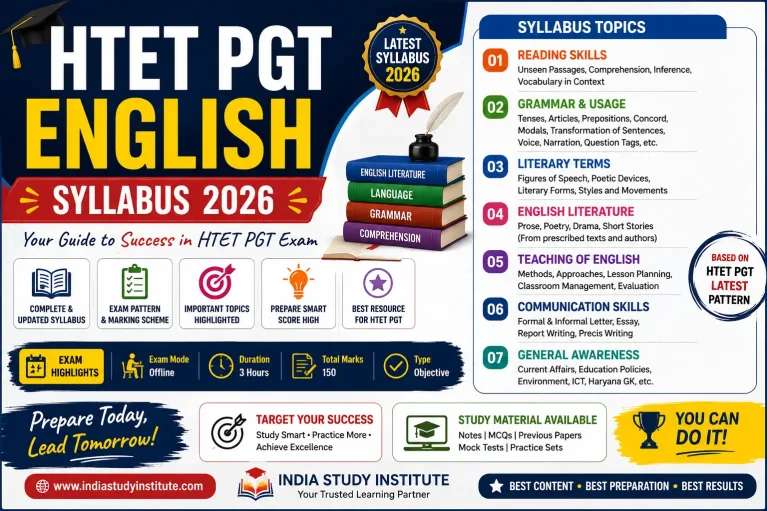
HTET PGT English Syllabus 2026
English at HTET Level-3 splits cleanly into two demands. One is literary: periods, movements, major authors and the critical vocabulary to discuss them. The other is linguistic and pedagogical - phonetics, syntax, error analysis, and the methods behind teaching a second language to senior students. Strong readers sometimes underprepare the second half and lose marks that were entirely winnable.
This page lists the full official syllabus for both: sixty marks of core English, the ninety marks of common papers shared with every other Level-3 subject, and the exam pattern the Board has notified for 2026.
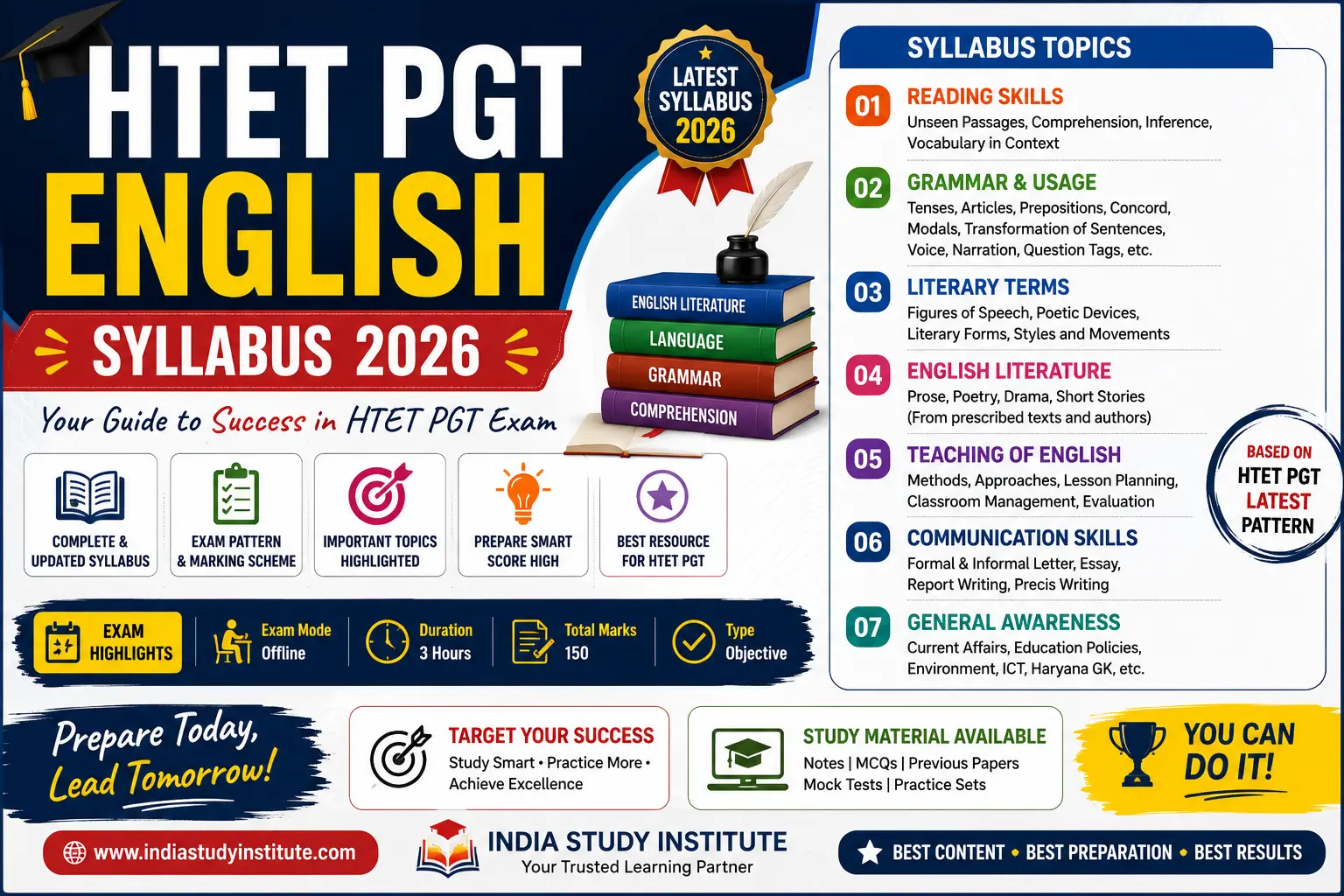
HTET PGT English Exam Pattern at a Glance - HTET PGT English Syllabus 2026
The mark distribution is worth fixing in your head before you look at the topics. The exam consists of 150 Multiple Choice Questions (MCQs) worth 150 marks, with a duration of 2.5 hours and no negative marking:
| Child Development and Pedagogy: | 30 Questions / 30 Marks |
| Languages (Hindi 15 & English 15): | 30 Questions / 30 Marks |
| General Studies (Quant, Reasoning, Haryana GK): | 30 Questions / 30 Marks |
| Core Political Science Syllabus: | 60 Questions / 60 Marks |
Part 1: Common Subjects Syllabus (90 Marks) - HTET PGT English Science Syllabus 2026
Securing high scores in the common section is the secret to clearing the cut-off. Here are the mandatory sections every candidate must prepare.
1. Child Development & Psychology (30 Marks)
This section evaluates your understanding of educational psychology tailored to teaching adolescents (ages 14–17). HTET Child Development and Psychology practice questions for complete notes
- Child Development: Concepts of development and its relationship with learning; principles of child development; and the influence of Heredity & Environment.
- Key Theories: Critical perspectives of Piaget, Kohlberg, and Vygotsky; Freud's Psychosexual Development Theory; Erikson's Psychosocial Theory; and Bandura's Social Learning Theory.
- Inclusive Education: Addressing diverse learners, socioeconomic disadvantages, learning disabilities, and nurturing gifted/specially-abled children.
- Learning & Pedagogy: How children think and learn; motivation; alternative conceptions of learning; assessing children’s "errors" as cognitive steps; and Continuous & Comprehensive Evaluation (CCE) frameworks.
2. Language Proficiency (30 Marks)
Split evenly between Hindi and English, this tests your foundational linguistic control and pedagogy for HTET PGT English Syllabus 2026.
- Hindi Language (15 Marks): Unseen passages assessing comprehension, inferences, and verbal ability. Structural grammar, pedagogical principles of language teaching, handling diverse classrooms, and language disorders. Hindi Grammar question bank to read and practice all the questions related to HTET PGT Computer Science.
- English Language (15 Marks): Unseen prose passages (literary, scientific, or narrative) testing comprehension, grammar, and vocabulary. Pedagogy of language acquisition, speech-listening mechanics, structural syntax, and standard teaching aids. English Grammar question bankfor English.
3. General Studies (30 Marks)
A composite section designed to test your mental aptitude and local awareness for HTET PGT English Syllabus 2026.
- Quantitative Aptitude (10 Marks): Whole numbers, fractions, decimals, percentages, profit & loss, ratio & proportion, time & work, averages, basic algebra, geometry (triangles, circles), basic trigonometry, and data graphs (pie charts, histograms).
- General Intelligence & Reasoning (10 Marks): Verbal and non-verbal reasoning, analogies, space visualization, coding & decoding, syllogisms, Venn diagrams, pattern folding/unfolding, embedded figures, and social/emotional intelligence.
- Haryana GK and Awareness (10 Marks): Local state history, geography, civics, environment, regional culture, arts, traditions, current affairs, and active state welfare schemes. Haryana GK practice questions
Part I: Core Subject – English (60 Marks)
This section rigorously tests your language competence, grammatical accuracy, phonetics, and literary knowledge. While the literature is based on the Haryana Board syllabus for classes 9th to 12th, the difficulty level of the questions can extend up to the Post-Graduate level.
A) Reading Comprehension & Pedagogy
- Reading Comprehension: One or two unseen passages (prose or poem) designed to assess your language competence. This will test your necessary skills to derive meaning, analyze, and interpret information gathered through reading.
- Language Pedagogy: Aims and objectives of teaching English at the school level. Methods and approaches to teaching the English language, along with the use of ICT (Information and Communication Technology) of/for/in Education.
B) Grammar, Usage & Phonetics
- Grammar and Usage: Questions will be based on verb patterns, tenses, analysis of sentences, and transformation of sentences. It also heavily covers voices (active/passive), narration (direct/indirect), articles, determiners, and auxiliaries (Primary and Modal).
- Vocabulary & Parts of Speech: Idiomatic expressions, phrasal verbs, and detailed identification/usage of parts of speech (Noun, pronoun, verb, adjective, adverb, conjunction, interjection, preposition).
- Basic Phonetics: Word formation, vowel and consonant sounds, simple transcription, stress, and intonation.
C) Literature
- Text-Based Questions: Literature questions will be selected directly from the prescribed English syllabus of the Board of School Education Haryana for classes IX to XII. As noted, the complexity of these questions may be elevated to the PG Level.


0 Comments
Be the first to comment.
Leave a comment
Your email will not be published. Comments are reviewed before appearing.