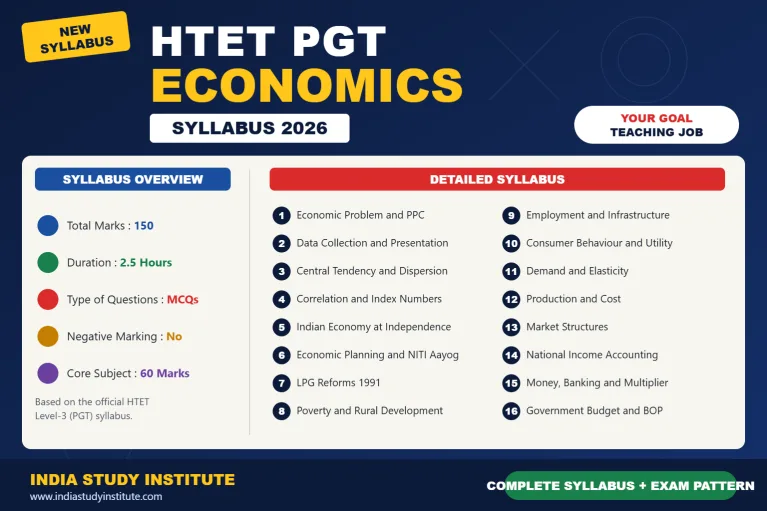
HTET PGT Economics Syllabus 2026
Economics at Level-3 asks you to move between two registers. Micro and macro theory demand analytical reasoning; Indian economic development and statistics demand recall of policy, data and institutions. Questions frequently cross that line inside a single item, which is why theory-only preparation tends to stall.
What follows is the complete official Board syllabus - statistics for economics, Indian economic development, microeconomics and macroeconomics - together with the ninety marks of common papers shared across every Level-3 subject and the full 2026 exam pattern.
HTET PGT Economics Exam Pattern
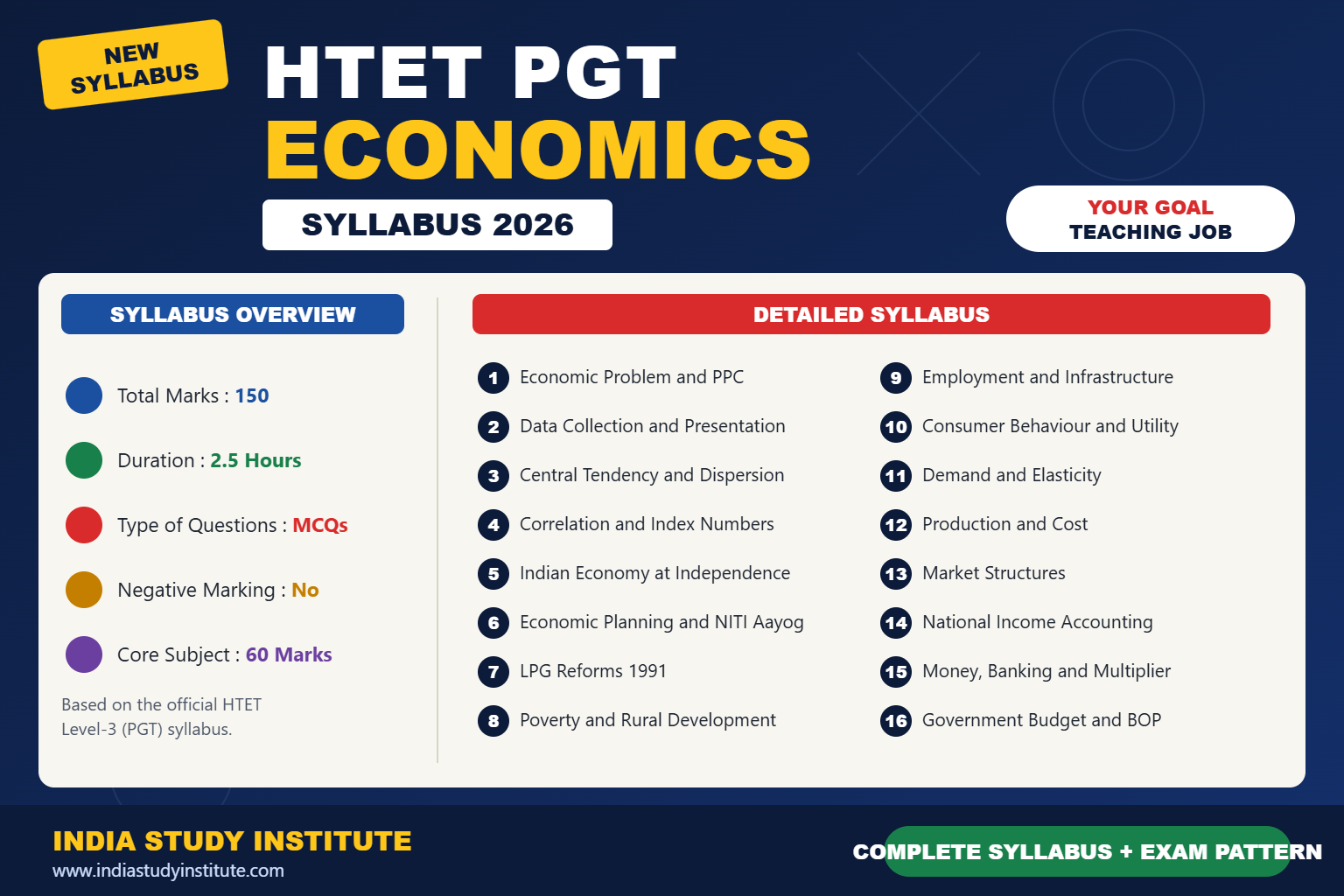
Before the topics, get the structure straight. The paper is 150 multiple choice questions worth 150 marks, to be attempted in 2.5 hours. There is no negative marking, so leaving a question blank costs you the same as getting it wrong - attempt everything.
- Child Development and Pedagogy: 30 questions / 30 marks
- Languages (Hindi 15 and English 15): 30 questions / 30 marks
- General Studies (Quantitative Aptitude, Reasoning, Haryana GK): 30 questions / 30 marks
- Core Subject - Economics: 60 questions / 60 marks
- Total: 150 questions / 150 marks / 2.5 hours / no negative marking
Keep this HTET PGT Economics Syllabus 2026 breakdown open while you build your study plan. Each topic below appears in the official notification.
Part I: Common Subjects (90 Marks)
Every HTET Level-3 candidate answers the same 90 marks of common papers, whatever their teaching subject. This is where most candidates gain or lose their margin.
1. Child Development and Pedagogy (30 Marks)
This section tests your understanding of educational psychology as it applies to teaching senior secondary students.
- Child Development: Concept of development and its relationship with learning; principles of the development of children; influence of heredity and environment; socialization processes involving teachers, parents and peers.
- Key Theories: Piaget, Kohlberg and Vygotsky - constructs and critical perspectives; Freud's psychosexual development theory; Erikson's theory of psychosocial development; Bandura's social learning theory.
- Concepts and Intelligence: Child-centred and progressive education; critical perspective on the construct of intelligence; multi-dimensional intelligence; language and thought; gender as a social construct, gender roles and educational practice.
- Individual Differences: Understanding differences based on diversity of language, caste, gender, community and religion.
- Assessment: Distinction between assessment for learning and assessment of learning; school-based assessment; Continuous and Comprehensive Evaluation; formulating appropriate questions to assess readiness levels, enhance learning and critical thinking, and measure learner achievement.
- Inclusive Education: Understanding children with special needs; addressing learners from diverse, disadvantaged and deprived backgrounds; addressing children with learning difficulties and impairments; addressing talented, creative and specially abled learners.
- Learning and Pedagogy: How children think and learn, and why they sometimes fail to succeed in school; basic processes of teaching and learning; children's strategies of learning; learning as a social activity; the child as a problem solver and scientific investigator; understanding children's errors as significant steps in learning; cognition and emotions; motivation and learning; personal and environmental factors contributing to learning.
2. Languages (30 Marks)
The language paper is split evenly between Hindi and English, 15 marks each.
- Hindi (15 Marks): Reading an unseen passage from prose, drama or poetry with questions on comprehension, inference, grammar and verbal ability. Pedagogy of language development covering learning and acquisition, principles of language teaching, the role of listening and speaking, a critical perspective on the role of grammar, challenges of teaching language in a diverse classroom, language difficulties, errors and disorders, and teaching-learning materials.
- English (15 Marks): One unseen prose passage (discursive, literary, narrative or scientific) with questions on comprehension, grammar and verbal ability. Pedagogy of language development covering the same set of principles, plus textbooks, multi-media materials and multilingual resources of the classroom.
3. General Studies (30 Marks)
A composite section of three equal parts, testing aptitude, reasoning and state awareness.
- Quantitative Aptitude (10 Marks): Whole numbers, fractions and decimals, percentages, profit and loss, ratio and proportion, time and work, averages, basic algebra, geometry of triangles and circles, basic trigonometry, and interpretation of data graphs such as pie charts and histograms.
- Reasoning Ability (10 Marks): Verbal and non-verbal reasoning, analogies, space visualization, coding and decoding, syllogisms, Venn diagrams, pattern folding and unfolding, embedded figures, and social and emotional intelligence.
- Haryana General Knowledge and Awareness (10 Marks): State history, geography, civics, environment, regional culture, arts and traditions, current affairs, and active state welfare schemes.
Part II: Core Subject - Economics (60 Marks)
Questions are based on topics from the Class 9 to 12 syllabus prescribed by the Education Department of Haryana. The difficulty level, however, extends up to the post-graduate standard, so expect familiar topics to be tested at a much deeper conceptual level.
A) Statistics for Economics & Indian Economic Development
- Economics: Meaning, definitions, scope, the economic problem and the Production Possibility Curve (PPC).
- Data Collection: Sources of data; methods of data collection; National Sample Survey Organization (NSSO); Census of India.
- Data Presentation: Geometric forms (bar and pie diagrams); frequency diagrams (histogram, polygon, ogive); arithmetic line graphs (time series graphs).
- Measures of Central Tendency: Arithmetic mean (simple and weighted), harmonic mean, geometric mean, median, mode, decile, quartile, percentile.
- Measures of Dispersion: Range, quartile deviation, mean deviation, standard deviation, measures of relative dispersion.
- Correlation: Scatter diagram; Karl Pearson's method; Spearman's rank correlation; concurrent deviation method.
- Index Numbers: Meaning and types; uses; Consumer Price Index (CPI); Wholesale Price Index; AICPIN; time and factor reversal tests; base shifting.
- Indian Economy on the Eve of Independence: Characteristics of the Indian economy pre and post independence.
- Economic Planning: Meaning; Planning Commission; characteristics of Indian economic planning; Five Year Plans and their success and failure; Green Revolution; NITI Aayog.
- New Economic Reforms: New Economic Policy 1991; Liberalization, Privatization and Globalization (LPG).
B) Poverty, Infrastructure & Micro Economics
- Poverty: Types of poverty; data analysis of poverty in India; poverty alleviation programmes.
- Rural Development: Rural development programmes; agricultural credit; cooperative banks; agricultural marketing; NABARD.
- Employment: Meaning; types of unemployment; employment generation programmes.
- Infrastructure: Energy, transport and communication, irrigation, health, financial institutions.
- Sustainable Development: Meaning; measurement; role of environment; environmental pollution.
- Gross Domestic Product: Concepts of national income; Human Development Index (HDI); HPI and PQLI indices.
- Micro Economics: Definitions, nature, scope and limitations; central problems; PPC and its applications; capitalist, mixed and socialist economies; opportunity cost.
- Consumer Behaviour: Cardinal and ordinal utility analysis; budget line; indifference curves and their characteristics; consumer equilibrium; marginal rate of substitution.
- Demand Analysis: Law of demand; normal, inferior and Giffen goods; determinants and exceptions; price, income and substitution effects; Hicks' and Slutsky's theory; revealed preference approach.
- Elasticity of Demand: Degrees, types and measurement; importance of price and income elasticity.
- Production and Cost: Production function; law of returns to scale and to a factor; economies and diseconomies of scale; MRTS; classical and modern theory of cost; short run and long run costs; relationship between cost curves.
C) Market Structures & Macro Economics
- Revenue: Concepts of revenue and their inter-relationship.
- Markets: Perfect competition; equilibrium of firm and industry; supply curve; market price and normal price; control price and support price; Food Availability Decline (FAD) theory.
- Monopoly, Monopolistic Competition and Oligopoly: Features and comparison of various models of oligopoly and duopoly.
- Macroeconomics: Nature, scope and limitations; stock and flow; circular flow of income; real and monetary flow; two, three and four sector models; withdrawals and injections.
- National Income: Concepts; income, product and expenditure methods; national income accounting; nominal national income; real GDP; GNP deflator.
- Money and Banking: Meaning and definitions of money; near money; functions of money; money supply and its determinants; RBI and its role in controlling money supply; functions of commercial and central banks; credit creation.
- Determination of Output and Employment: AD and AS analysis; MPC, APC, APS, MPS, MEC; supply price; prospective yield; classical and Keynesian approaches to employment; consumption hypothesis.
- Investment Multipliers: Meaning; MPC and multiplier; forward and backward action; static and dynamic multiplier.
- Deficient and Excess Demand: Inflationary gap; measures of control; role of monetary policy, fiscal policy and foreign trade policy.
- Government Budget: Meaning, objectives and structure; budget receipts; tax and non-tax receipts; budget expenditure; budget deficit - meaning, types and measurement; deficit budgeting; balanced budget.
- Foreign Exchange and BOP: Exchange rate meaning, types and theories; Balance of Payments components; disequilibrium in BOP and methods of control; BOP in economic plans; Balance of Trade.
Subject-Related Pedagogy
The core paper also carries questions on the teaching of Economics itself: teaching strategies and methods, instructional tools and teaching aids, curriculum transaction, practical and activity based approaches, and assessment techniques appropriate to the senior secondary level.
How to Prepare for HTET PGT Economics 2026
- Start with the common 90 marks - they are identical every year and the fastest marks to secure.
- Work through the core syllabus in the A, B and C order given above; it broadly follows the Class 9-10, Class 11 and Class 12 progression.
- Revise NCERT and Haryana Board textbooks first, then move to post-graduate level reference books for depth.
- Solve previous year HTET Level-3 papers to get used to the phrasing and the time pressure.
- Because there is no negative marking, practise attempting all 150 questions within 2.5 hours.
Official Notification & Practice Resources
Always cross-check the HTET PGT Economics Syllabus 2026 against the Board’s own notification before you finalise your plan. The syllabus is issued by the Board of School Education Haryana — visit the official BSEH website or read the HTET information bulletin (PDF).
The 90 common marks are the easiest place to gain ground on the HTET PGT Economics Syllabus 2026. Practise them here:
- Psychology Practice Set – for Child Development & Pedagogy
- Hindi Grammar Practice Set
- English Grammar Practice Set
- Reasoning Practice Set
- Mathematics Practice Set
- Haryana GK Practice Set
Other HTET PGT Level-3 syllabus guides: Physics, Chemistry, Biology, Mathematics, Commerce, Economics, English and Computer Science.
Bookmark this page - we update this HTET PGT Economics Syllabus 2026 guide whenever the Board of School Education Haryana (BSEH) revises the official syllabus or releases a new notification.


0 Comments
Be the first to comment.
Leave a comment
Your email will not be published. Comments are reviewed before appearing.