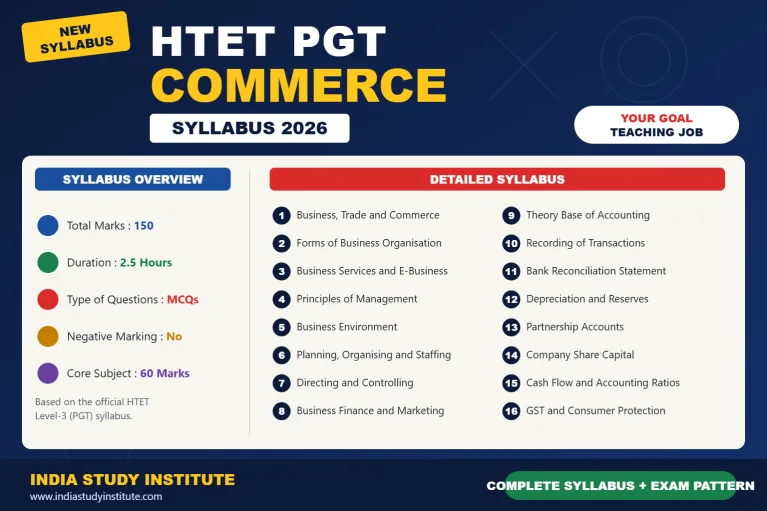
HTET PGT Commerce Syllabus 2026
Commerce covers two fairly separate bodies of knowledge. Business studies and management principles are conceptual and discursive; financial and company accounts are procedural, where a misremembered treatment costs the whole mark. Both sit inside the same sixty-mark section.
The official syllabus for both halves is set out below, alongside the ninety marks of common papers every Level-3 candidate answers and the exam pattern notified by the Board for 2026.
HTET PGT Commerce Exam Pattern
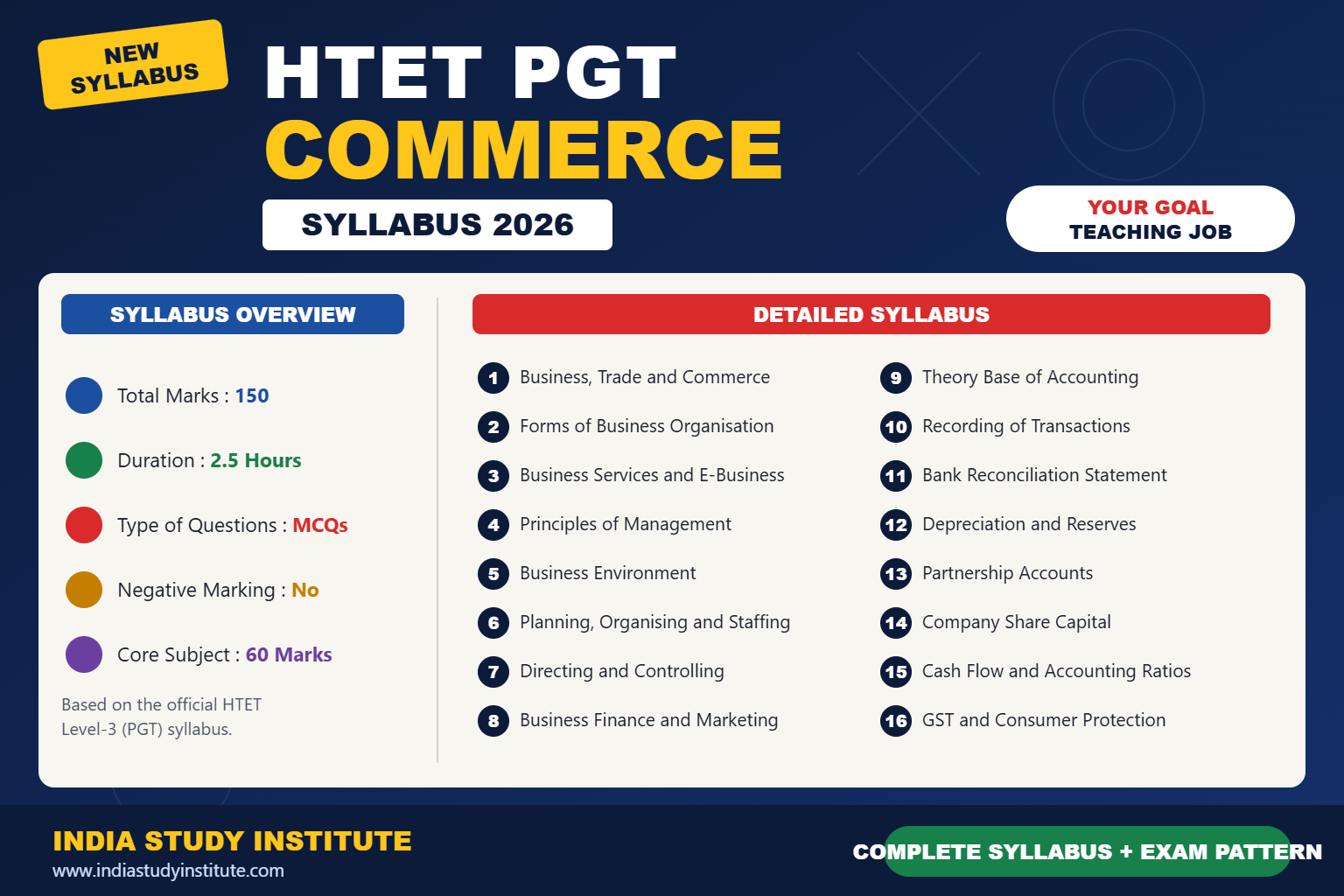
Before the topics, get the structure straight. The paper is 150 multiple choice questions worth 150 marks, to be attempted in 2.5 hours. There is no negative marking, so leaving a question blank costs you the same as getting it wrong - attempt everything.
- Child Development and Pedagogy: 30 questions / 30 marks
- Languages (Hindi 15 and English 15): 30 questions / 30 marks
- General Studies (Quantitative Aptitude, Reasoning, Haryana GK): 30 questions / 30 marks
- Core Subject - Commerce: 60 questions / 60 marks
- Total: 150 questions / 150 marks / 2.5 hours / no negative marking
Keep this HTET PGT Commerce Syllabus 2026 breakdown open while you build your study plan. Everything below is drawn from the Board's own notification.
Part I: Common Subjects (90 Marks)
Every HTET Level-3 candidate answers the same 90 marks of common papers, whatever their teaching subject. The cut-off is usually decided here rather than in the subject paper.
1. Child Development and Pedagogy (30 Marks)
This section tests your understanding of educational psychology as it applies to teaching senior secondary students.
- Child Development: Concept of development and its relationship with learning; principles of the development of children; influence of heredity and environment; socialization processes involving teachers, parents and peers.
- Key Theories: Piaget, Kohlberg and Vygotsky - constructs and critical perspectives; Freud's psychosexual development theory; Erikson's theory of psychosocial development; Bandura's social learning theory.
- Concepts and Intelligence: Child-centred and progressive education; critical perspective on the construct of intelligence; multi-dimensional intelligence; language and thought; gender as a social construct, gender roles and educational practice.
- Individual Differences: Understanding differences based on diversity of language, caste, gender, community and religion.
- Assessment: Distinction between assessment for learning and assessment of learning; school-based assessment; Continuous and Comprehensive Evaluation; formulating appropriate questions to assess readiness levels, enhance learning and critical thinking, and measure learner achievement.
- Inclusive Education: Understanding children with special needs; addressing learners from diverse, disadvantaged and deprived backgrounds; addressing children with learning difficulties and impairments; addressing talented, creative and specially abled learners.
- Learning and Pedagogy: How children think and learn, and why they sometimes fail to succeed in school; basic processes of teaching and learning; children's strategies of learning; learning as a social activity; the child as a problem solver and scientific investigator; understanding children's errors as significant steps in learning; cognition and emotions; motivation and learning; personal and environmental factors contributing to learning.
2. Languages (30 Marks)
The language paper is split evenly between Hindi and English, 15 marks each.
- Hindi (15 Marks): Reading an unseen passage from prose, drama or poetry with questions on comprehension, inference, grammar and verbal ability. Pedagogy of language development covering learning and acquisition, principles of language teaching, the role of listening and speaking, a critical perspective on the role of grammar, challenges of teaching language in a diverse classroom, language difficulties, errors and disorders, and teaching-learning materials.
- English (15 Marks): One unseen prose passage (discursive, literary, narrative or scientific) with questions on comprehension, grammar and verbal ability. Pedagogy of language development covering the same set of principles, plus textbooks, multi-media materials and multilingual resources of the classroom.
3. General Studies (30 Marks)
A composite section of three equal parts, testing aptitude, reasoning and state awareness.
- Quantitative Aptitude (10 Marks): Whole numbers, fractions and decimals, percentages, profit and loss, ratio and proportion, time and work, averages, basic algebra, geometry of triangles and circles, basic trigonometry, and interpretation of data graphs such as pie charts and histograms.
- Reasoning Ability (10 Marks): Verbal and non-verbal reasoning, analogies, space visualization, coding and decoding, syllogisms, Venn diagrams, pattern folding and unfolding, embedded figures, and social and emotional intelligence.
- Haryana General Knowledge and Awareness (10 Marks): State history, geography, civics, environment, regional culture, arts and traditions, current affairs, and active state welfare schemes.
Part II: Core Subject - Commerce (60 Marks)
Questions are based on topics from the Class 9 to 12 syllabus prescribed by the Education Department of Haryana. The difficulty level, however, extends up to the post-graduate standard, so expect familiar topics to be tested at a much deeper conceptual level.
A) Business Studies & Principles of Management
- Business, Trade and Commerce: Business an introduction; classification of business activities; business risk - nature and causes.
- Forms of Business Organisation: Sole proprietorship; Joint Hindu Family business; partnership; co-operative society; company organisation; choice of form of business organisation.
- Private, Public and Global Enterprise: Departmental undertaking; statutory corporation; government company; global enterprise / multinational company; public private partnership (PPP).
- Business Services: Banking, insurance, postal and telecom services.
- Emerging Modes of Business: E-commerce and e-business.
- Social Responsibility of Business: Social responsibility and business ethics.
- Nature and Significance of Management: Management an introduction; nature and levels of management; functions of management; co-ordination.
- Principles of Management: Taylor's principles of scientific management; Fayol's general principles of management.
- Business Environment: Concept and dimensions of business environment; concept of demonetisation.
- Planning, Organising and Staffing: Concept and types of plans; organising as a process; organisational structure; delegation and decentralisation; staffing - meaning, importance, recruitment, selection, training and development.
- Directing and Controlling: Importance and principles of directing; supervision, motivation, leadership, communication; concept, process and techniques of controlling.
- Business Finance and Marketing: Financial management; financial decisions and planning; capital structure; fixed and working capital; marketing and elements of the marketing mix.
B) Financial Accounting & Partnership Accounts
- Introduction to Accounting: Concept of accounting; basic accounting terms.
- Theory Base of Accounting: Fundamental accounting assumptions; GAAP; basic accounting concepts; systems and basis of accounting; accounting standards; Goods and Services Tax.
- Recording of Transactions: Business transactions and source documents; accounting equation; double entry system; journal; ledger; cash book; subsidiary books.
- Bank Reconciliation Statement: Preparation as per cash book and as per pass book.
- Trial Balance and Rectification of Errors.
- Depreciation, Provisions and Reserves.
- Financial Statements with adjustments of a sole proprietorship.
- Accounting for Partnership - Basic Concepts: Fundamentals of partnership; special aspects of partnership accounts; maintenance of capital accounts; distribution of profit; past adjustments; guarantee of profit to a partner.
- Admission of a Partner: Change in profit sharing ratio; goodwill; new profit sharing and sacrificing ratio; treatment of goodwill; adjustment of reserves, accumulated profits and losses; revaluation of assets and reassessment of liabilities; adjustment of capitals.
- Retirement or Death of a Partner: Ascertaining the amount due; new profit sharing and gaining ratio; treatment of goodwill; adjustments of reserves and revaluation; disposal of amount due; death of a partner.
- Dissolution of Partnership Firm: Dissolution of partnership and firm; settlement of accounts; accounting treatment.
C) Company Accounts, Computerised Accounting & Trade
- Formation of a Company: Stages in formation; documents used in formation.
- Sources of Business Finance: Concept; owned funds and borrowed funds.
- Accounting for Share Capital: Meaning, nature and types of share capital; nature and classes of shares; accounting treatment of issue and forfeiture of shares.
- Issue of Debentures: Meaning and types; accounting treatment; terms of issue; interest on debentures; writing off discount or loss on issue.
- Financial Statements of a Company: Types of financial statements.
- Accounting Ratios: Types, meaning, objectives, advantages and limitations.
- Cash Flow Statement: Classification of activities; preparation as per AS-3.
- Computerised Accounting System: Application in accounting; features and structure of CAS; software packages - generic, specific and tailored; installation steps; codification and hierarchy of account heads; creation of accounts; data entry, validation and verification; adjusting entries; preparation of balance sheet and profit and loss account; need and security features.
- Electronic Spreadsheet: Concept and features; application in generating accounting information - bank reconciliation statement, asset accounting, loan and repayment schedules, ratio analysis; data representation through graphs, charts and diagrams.
- MSME and Entrepreneurship: Meaning of small scale enterprise as per MSMED Act 2006; entrepreneurship; meaning and types of intellectual property rights.
- Internal and International Trade: Wholesale and retail trade; GST; international trade an introduction; international trade institutions and agreements.
- Consumer Protection: Introduction and importance; Consumer Protection Act 1986 (amendments in 2019).
Subject-Related Pedagogy
The core paper also carries questions on the teaching of Commerce itself: teaching strategies and methods, instructional tools and teaching aids, curriculum transaction, practical and activity based approaches, and assessment techniques appropriate to the senior secondary level.
How to Prepare for HTET PGT Commerce 2026
- Start with the common 90 marks - they are identical every year and the fastest marks to secure.
- Work through the core syllabus in the A, B and C order given above; it broadly follows the Class 9-10, Class 11 and Class 12 progression.
- Revise NCERT and Haryana Board textbooks first, then move to post-graduate level reference books for depth.
- Solve previous year HTET Level-3 papers to get used to the phrasing and the time pressure.
- Because there is no negative marking, practise attempting all 150 questions within 2.5 hours.
Official Notification & Practice Resources
Always cross-check the HTET PGT Commerce Syllabus 2026 against the Board’s own notification before you finalise your plan. The syllabus is issued by the Board of School Education Haryana — visit the official BSEH website or read the HTET information bulletin (PDF).
The 90 common marks are the easiest place to gain ground on the HTET PGT Commerce Syllabus 2026. Practise them here:
- Psychology Practice Set – for Child Development & Pedagogy
- Hindi Grammar Practice Set
- English Grammar Practice Set
- Reasoning Practice Set
- Mathematics Practice Set
- Haryana GK Practice Set
Other HTET PGT Level-3 syllabus guides: Physics, Chemistry, Biology, Mathematics, Commerce, Economics, English and Computer Science.
Bookmark this page - we update this HTET PGT Commerce Syllabus 2026 guide whenever the Board of School Education Haryana (BSEH) revises the official syllabus or releases a new notification.


0 Comments
Be the first to comment.
Leave a comment
Your email will not be published. Comments are reviewed before appearing.