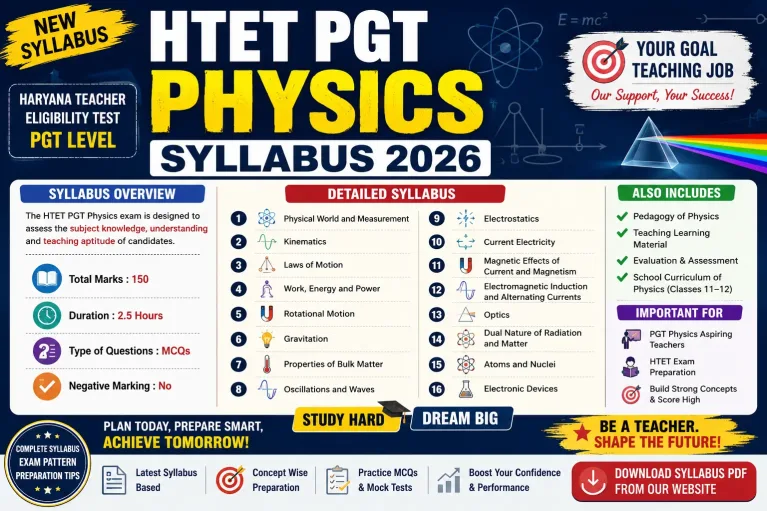
HTET PGT Physics Syllabus 2026
Physics rewards a particular kind of preparation. The Level-3 syllabus runs from mechanics and thermodynamics through electromagnetism, optics and modern physics, and the questions tend to be calculation-led - which means formula recall alone is rarely enough. You need to recognise which principle a problem is actually testing before the arithmetic starts.
Set out below is the complete official breakdown from the Board of School Education Haryana: sixty marks of core Physics, the ninety marks of common papers taken by every Level-3 candidate, and the full exam pattern for 2026.
HTET PGT Physics Exam Pattern at a Glance - HTET PGT Physics Syllabus 2026
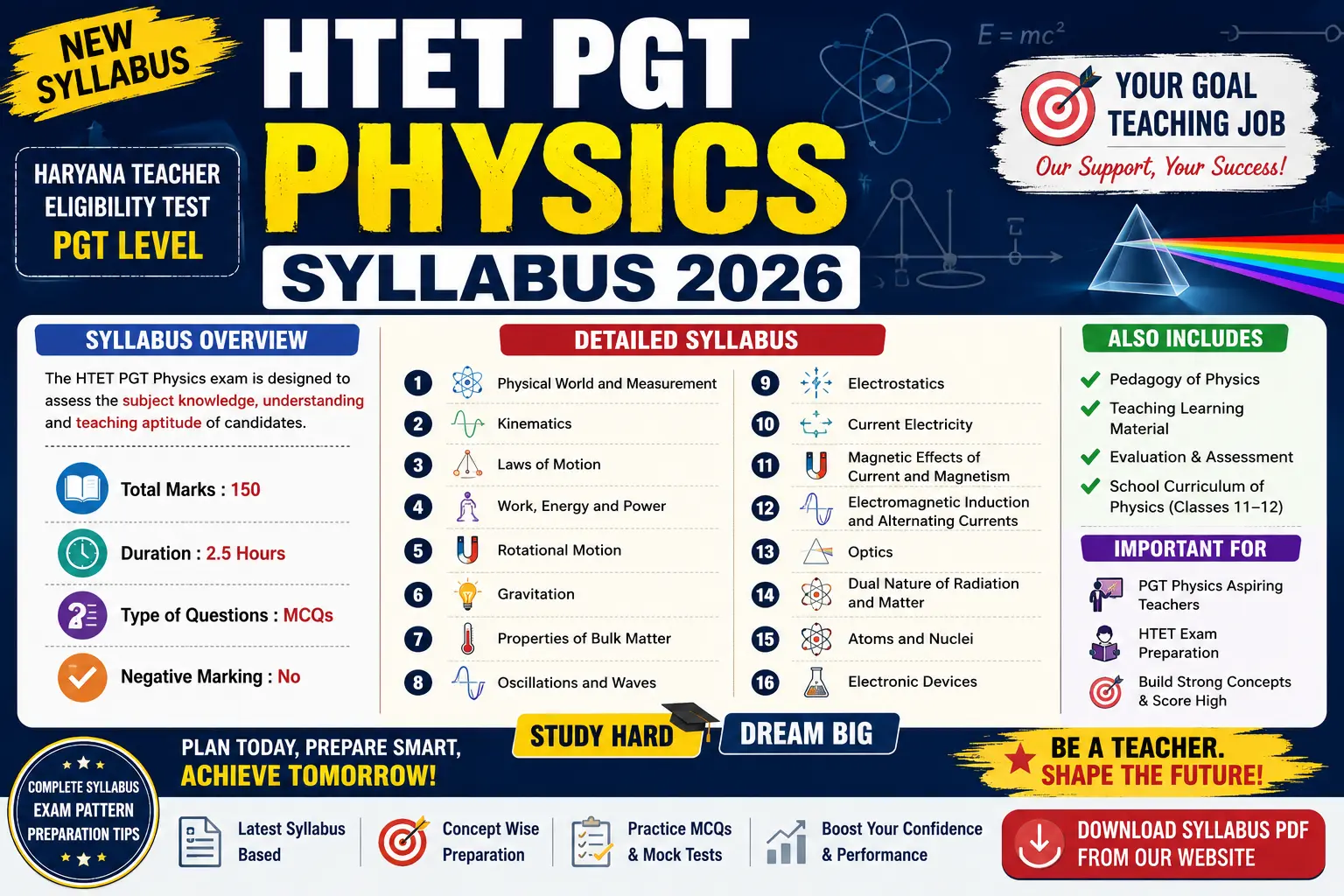
Start with how the marks are split - it shapes everything that follows. The exam consists of 150 Multiple Choice Questions (MCQs) worth 150 marks, with a duration of 2.5 hours and no negative marking:
| Child Development and Pedagogy: | 30 Questions / 30 Marks |
| Languages (Hindi 15 & English 15): | 30 Questions / 30 Marks |
| General Studies (Quant, Reasoning, Haryana GK): | 30 Questions / 30 Marks |
| Core Physics Syllabus: | 60 Questions / 60 Marks |
Part 1: Common Subjects Syllabus (90 Marks) - HTET PGT Physics Syllabus 2026
Securing high scores in the common section is the secret to clearing the cut-off. Here are the mandatory sections every candidate must prepare.
1. Child Development & Psychology (30 Marks)
This section evaluates your understanding of educational psychology tailored to teaching adolescents (ages 14–17). HTET Child Development and Psychology practice questions for complete notes
- Child Development: Concepts of development and its relationship with learning; principles of child development; and the influence of Heredity & Environment.
- Key Theories: Critical perspectives of Piaget, Kohlberg, and Vygotsky; Freud's Psychosexual Development Theory; Erikson's Psychosocial Theory; and Bandura's Social Learning Theory.
- Inclusive Education: Addressing diverse learners, socioeconomic disadvantages, learning disabilities, and nurturing gifted/specially-abled children.
- Learning & Pedagogy: How children think and learn; motivation; alternative conceptions of learning; assessing children’s "errors" as cognitive steps; and Continuous & Comprehensive Evaluation (CCE) frameworks.
2. Language Proficiency (30 Marks)
Split evenly between Hindi and English, this tests your foundational linguistic control and pedagogy for HTET PGT Physics Syllabus 2026.
- Hindi Language (15 Marks): Unseen passages assessing comprehension, inferences, and verbal ability. Structural grammar, pedagogical principles of language teaching, handling diverse classrooms, and language disorders. Hindi Grammar question bank to read and practice all the questions related to HTET PGT Computer Science.
- English Language (15 Marks): Unseen prose passages (literary, scientific, or narrative) testing comprehension, grammar, and vocabulary. Pedagogy of language acquisition, speech-listening mechanics, structural syntax, and standard teaching aids. English Grammar question bankfor English.
3. General Studies (30 Marks)
A composite section designed to test your mental aptitude and local awareness for HTET PGT Physics Syllabus 2026.
- Quantitative Aptitude (10 Marks): Whole numbers, fractions, decimals, percentages, profit & loss, ratio & proportion, time & work, averages, basic algebra, geometry (triangles, circles), basic trigonometry, and data graphs (pie charts, histograms).
- General Intelligence & Reasoning (10 Marks): Verbal and non-verbal reasoning, analogies, space visualization, coding & decoding, syllogisms, Venn diagrams, pattern folding/unfolding, embedded figures, and social/emotional intelligence.
- Haryana GK and Awareness (10 Marks): Local state history, geography, civics, environment, regional culture, arts, traditions, current affairs, and active state welfare schemes. Haryana GK practice questions
Part II: Core Subject – Physics (60 Marks)
While questions are based on topics from the Class 9th to 12th syllabus prescribed by the Education Department of Haryana, their difficulty level and conceptual connections can extend up to the Post-Graduate level.
A) Mechanics & Waves
- Units and Measurement: System of units, measurement errors, dimensional analysis.
- Kinematics: Motion in a straight line, motion in a plane, vectors, projectile motion, uniform circular motion.
- Laws of Motion & Friction: Newton's laws of motion, momentum, force, static and kinetic friction, dynamics of uniform circular motion.
- Work, Energy, and Power: Work done by constant and variable forces, kinetic and potential energy, work-energy theorem, conservation of energy, elastic and inelastic collisions.
- System of Particles & Rotational Motion: Centre of mass, torque, angular momentum, conservation of angular momentum, moment of inertia, radius of gyration, rotational dynamics.
- Gravitation: Universal law of gravitation, Kepler's laws, acceleration due to gravity ($g$) and its variation, gravitational potential energy, escape velocity, orbital velocity of satellites.
- Properties of Bulk Matter:
- Solids: Elastic behavior, Stress-strain relationship, Hooke's law, Young's modulus, bulk modulus, shear modulus.
- Fluids: Pressure in fluids, Pascal's law, Archimedes' principle, viscosity, Stokes' law, terminal velocity, stream line and turbulent flow, Bernoulli's theorem, surface tension, capillarity.
- Thermal Physics & Thermodynamics: Thermal expansion, calorimetry, latent heat, heat transfer (conduction, convection, radiation), zeroth, first, and second laws of thermodynamics, reversible and irreversible processes, heat engines, refrigerators.
- Kinetic Theory of Gases: Equation of state of a perfect gas, kinetic theory assumptions, concept of pressure, RMS speed, degrees of freedom, law of equipartition of energy, mean free path.
- Oscillations & Waves: Simple Harmonic Motion (SHM), kinetic and potential energy in SHM, damped and forced oscillations, resonance; Wave motion, transverse and longitudinal waves, speed of wave, superposition principle, beats, Doppler effect.
B) Electromagnetism
- Electrostatics: Electric charges, Coulomb's law, electric field, electric dipole, Gauss's law and its applications; Electrostatic potential, equipotential surfaces, conductors and dielectrics, capacitors, capacitance in series and parallel, energy stored in capacitors.
- Current Electricity: Electric current, Ohm's law, electrical resistance, resistivity, temperature dependence of resistance, internal resistance of cells, Kirchhoff's laws and applications (Wheatstone bridge, potentiometer).
- Magnetic Effects of Current & Magnetism: Biot-Savart law, Ampere's law and applications, motion of charged particles in electric and magnetic fields (cyclotron), force on a current-carrying conductor, magnetic dipole moment, torque on a magnetic dipole, Earth's magnetic field, magnetic properties of materials (dia-, para-, ferro-magnetics).
- Electromagnetic Induction & Alternating Currents: Faraday's laws of induction, Lenz's law, self and mutual inductance; AC circuits, peak and RMS value of AC, reactance and impedance, LCR series circuit, resonance, power in AC circuits, wattless current, AC generators, transformers.
- Electromagnetic Waves: Displacement current, electromagnetic wave characteristics, electromagnetic spectrum (radio waves, microwaves, infrared, visible, ultraviolet, X-rays, gamma rays) and applications.
C) Light (Optics)
- Ray Optics and Optical Instruments: Reflection of light, spherical mirrors, refraction at spherical surfaces, total internal reflection, lenses, thin lens formula, lens maker's formula, magnification, prism refraction, dispersion; Optical instruments (microscopes, astronomical telescopes).
- Wave Optics: Wavefront, Huygens' principle, interference of light, Young's double-slit experiment, diffraction due to a single slit, resolving power of optical instruments, polarization of light, Brewster's law.
- Vision & Eye: Optical structure and functioning of the human eye, defects of vision (myopia, hypermetropia, presbyopia) and corrective lenses.
D) Modern Physics & Electronics
- Dual Nature of Radiation and Matter: Photoelectric effect, Hertz and Lenard's observations, Einstein's photoelectric equation, matter waves, de Broglie relation, Davisson-Germer experiment.
- Atoms and Nuclei: Alpha-particle scattering experiment, Rutherford's atomic model, Bohr's model of hydrogen atom, energy levels, hydrogen spectrum; Atomic nucleus composition, mass defect, binding energy per nucleon, radioactivity, alpha/beta/gamma decay, nuclear fission, nuclear fusion.
- Semiconductor Electronics: Energy bands in solids, intrinsic and extrinsic semiconductors, p-n junction diode, I-V characteristics, diode as rectifier, special purpose diodes (LED, photodiode, solar cell, Zener diode), simple electronic circuits.
E) Subject-Related Pedagogy
- Teaching strategies, instructional tools, curriculum transaction methods, laboratory approaches, and assessment methodologies relevant to Physics education at the senior secondary level.
For more information please visit
Other Important Links:


0 Comments
Be the first to comment.
Leave a comment
Your email will not be published. Comments are reviewed before appearing.