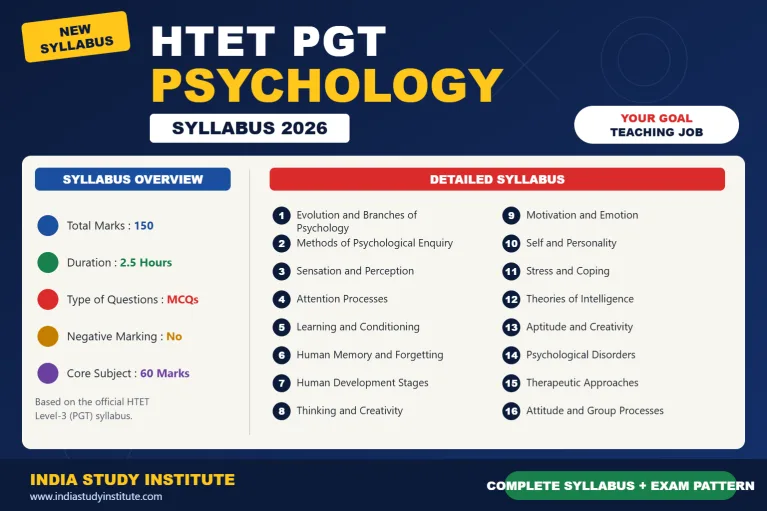
HTET PGT Psychology Syllabus 2026
Psychology at Level-3 overlaps more with the common Child Development paper than any other subject - which is an advantage worth planning around, since preparation for one genuinely strengthens the other. Cognitive processes, development, personality, disorders and social psychology make up the core.
Below is the full official syllabus for the sixty-mark Psychology section, the ninety marks of common papers taken by every Level-3 candidate, and the complete HTET 2026 exam pattern.
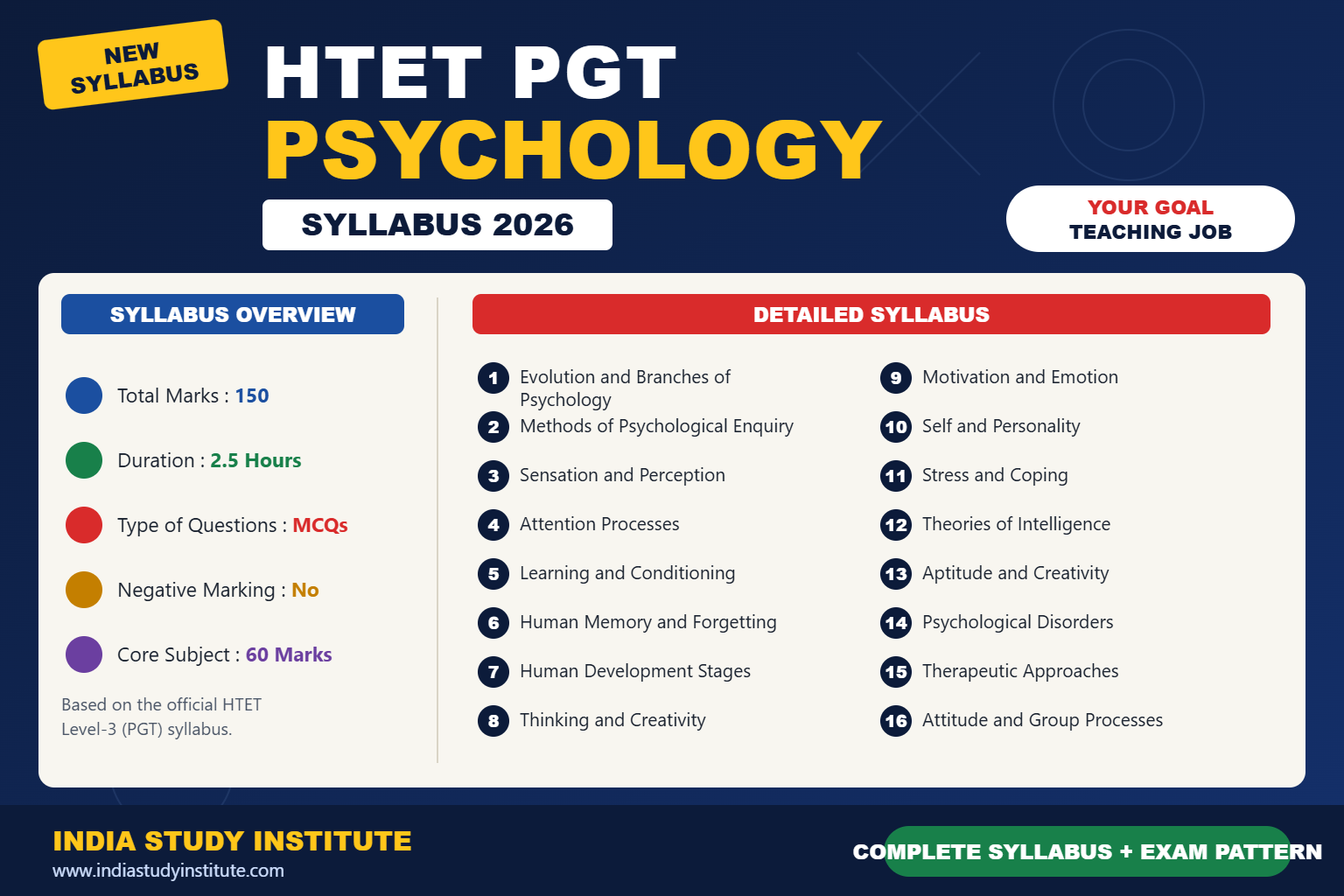
HTET PGT Psychology Exam Pattern
Before the topics, get the structure straight. The paper is 150 multiple choice questions worth 150 marks, to be attempted in 2.5 hours. There is no negative marking, so leaving a question blank costs you the same as getting it wrong - attempt everything.
- Child Development and Pedagogy: 30 questions / 30 marks
- Languages (Hindi 15 and English 15): 30 questions / 30 marks
- General Studies (Quantitative Aptitude, Reasoning, Haryana GK): 30 questions / 30 marks
- Core Subject - Psychology: 60 questions / 60 marks
- Total: 150 questions / 150 marks / 2.5 hours / no negative marking
Keep this HTET PGT Psychology Syllabus 2026 breakdown open while you build your study plan. The topics that follow come straight from the official BSEH syllabus.
Part I: Common Subjects (90 Marks)
Every HTET Level-3 candidate answers the same 90 marks of common papers, whatever their teaching subject. These sections separate candidates more often than the specialism does.
1. Child Development and Pedagogy (30 Marks)
This section tests your understanding of educational psychology as it applies to teaching senior secondary students.
- Child Development: Concept of development and its relationship with learning; principles of the development of children; influence of heredity and environment; socialization processes involving teachers, parents and peers.
- Key Theories: Piaget, Kohlberg and Vygotsky - constructs and critical perspectives; Freud's psychosexual development theory; Erikson's theory of psychosocial development; Bandura's social learning theory.
- Concepts and Intelligence: Child-centred and progressive education; critical perspective on the construct of intelligence; multi-dimensional intelligence; language and thought; gender as a social construct, gender roles and educational practice.
- Individual Differences: Understanding differences based on diversity of language, caste, gender, community and religion.
- Assessment: Distinction between assessment for learning and assessment of learning; school-based assessment; Continuous and Comprehensive Evaluation; formulating appropriate questions to assess readiness levels, enhance learning and critical thinking, and measure learner achievement.
- Inclusive Education: Understanding children with special needs; addressing learners from diverse, disadvantaged and deprived backgrounds; addressing children with learning difficulties and impairments; addressing talented, creative and specially abled learners.
- Learning and Pedagogy: How children think and learn, and why they sometimes fail to succeed in school; basic processes of teaching and learning; children's strategies of learning; learning as a social activity; the child as a problem solver and scientific investigator; understanding children's errors as significant steps in learning; cognition and emotions; motivation and learning; personal and environmental factors contributing to learning.
2. Languages (30 Marks)
The language paper is split evenly between Hindi and English, 15 marks each.
- Hindi (15 Marks): Reading an unseen passage from prose, drama or poetry with questions on comprehension, inference, grammar and verbal ability. Pedagogy of language development covering learning and acquisition, principles of language teaching, the role of listening and speaking, a critical perspective on the role of grammar, challenges of teaching language in a diverse classroom, language difficulties, errors and disorders, and teaching-learning materials.
- English (15 Marks): One unseen prose passage (discursive, literary, narrative or scientific) with questions on comprehension, grammar and verbal ability. Pedagogy of language development covering the same set of principles, plus textbooks, multi-media materials and multilingual resources of the classroom.
3. General Studies (30 Marks)
A composite section of three equal parts, testing aptitude, reasoning and state awareness.
- Quantitative Aptitude (10 Marks): Whole numbers, fractions and decimals, percentages, profit and loss, ratio and proportion, time and work, averages, basic algebra, geometry of triangles and circles, basic trigonometry, and interpretation of data graphs such as pie charts and histograms.
- Reasoning Ability (10 Marks): Verbal and non-verbal reasoning, analogies, space visualization, coding and decoding, syllogisms, Venn diagrams, pattern folding and unfolding, embedded figures, and social and emotional intelligence.
- Haryana General Knowledge and Awareness (10 Marks): State history, geography, civics, environment, regional culture, arts and traditions, current affairs, and active state welfare schemes.
Part II: Core Subject - Psychology (60 Marks)
Questions are based on topics from the Class 9 to 12 syllabus prescribed by the Education Department of Haryana. The difficulty level, however, extends up to the post-graduate standard, so expect familiar topics to be tested at a much deeper conceptual level.
A) Foundations, Methods & Cognitive Processes
- Understanding Mind and Behaviour: Popular notions about the discipline of psychology; evolution of psychology; development of psychology in India; branches of psychology; psychology and other disciplines; psychology in everyday life.
- Methods of Enquiry in Psychology: Goals of psychological enquiry; steps in conducting scientific research; alternative paradigms of research; nature of psychological data; observational method, experimental method, correlational research, survey research, psychological testing and case study; quantitative and qualitative analysis of data; limitations of psychological enquiry; ethical issues.
- Sensory, Attentional and Perceptual Processes: Knowing the world; nature and varieties of stimulus; sense modalities; functional limitations of sense organs; selective and sustained attention; perceptual processes and processing approaches; the perceiver; principles of perceptual organisation; perception of space, depth and distance - monocular and binocular cues; perceptual constancies; illusions; socio-cultural influences on perception.
- Learning: Nature and paradigms of learning; classical conditioning and its determinants; operant/instrumental conditioning and its determinants; key learning processes; observational, cognitive, verbal and skill learning; factors facilitating learning; learning disabilities.
- Human Memory: Nature of memory; information processing approach and the stage model; sensory, short-term and long-term memory; levels of processing; declarative and procedural, episodic and semantic memory; nature and causes of forgetting - trace decay, interference and retrieval failure; enhancing memory through mnemonics using images and organisation.
B) Human Development, Motivation, Personality & Stress
- Human Development: Meaning of development; life-span perspective; factors influencing development; context of development; overview of developmental stages - prenatal stage, infancy, childhood, challenges of adolescence, adulthood and old age.
- Thinking: Nature of thinking; building blocks of thought; processes of thinking; problem solving; reasoning; decision making; nature and process of creative thinking; thought and language; development of language and language use.
- Motivation and Emotion: Nature of motivation; types of motives - biological and psychosocial; Maslow's hierarchy of needs; nature and expression of emotions; culture and emotional expression; culture and emotional labelling; managing negative emotions; enhancing positive emotions.
- Self and Personality: Concept of self; cognitive and behavioural aspects of self; self-esteem, self-efficacy and self-regulation; culture and self; concept of personality; type, trait, psychodynamic, behavioural, cultural and humanistic approaches; assessment of personality through self-report, projective techniques and behavioural analysis.
- Stress: Effects of stress on psychological functioning and health; stress and health; general adaptation syndrome; stress and the immune system; life style; coping with stress and stress management techniques; promoting positive health and well-being; life skills.
C) Intelligence, Disorders, Therapy & Social Psychology
- Intelligence: Theories of intelligence - one factor theory, two factor theory, theory of primary mental abilities, structure of intellect model, theory of multiple intelligences, triarchic theory, PASS model; individual differences and variations in intelligence; culture and intelligence; emotional intelligence; aptitude - nature and measurement; creativity.
- Psychological Disorders: Concepts of abnormality and psychological disorder; historical background; classification of psychological disorders; factors underlying abnormal behaviour; anxiety disorders (generalised anxiety disorder, panic disorder, phobia, OCD, PTSD); somatoform disorders; dissociative disorders; mood disorders; schizophrenic disorders; behavioural and developmental disorders; substance use disorders.
- Therapeutic Approaches: Nature and process of psychotherapy; therapeutic relationship; behavioural therapy, cognitive therapy, cognitive behaviour therapy, humanistic existential therapy and alternative therapy; rehabilitation of the mentally ill.
- Attitude and Social Cognition: Social behaviour; nature and components of attitudes; attitude formation and change; attitude-behaviour relationship; prejudice and discrimination; strategies for handling prejudice.
- Social Influence and Group Processes: Nature and formation of groups; types of groups; influence of the group on individual behaviour; social learning; group polarisation.
Subject-Related Pedagogy
The core paper also carries questions on the teaching of Psychology itself: teaching strategies and methods, instructional tools and teaching aids, curriculum transaction, practical and activity based approaches, and assessment techniques appropriate to the senior secondary level.
How to Prepare for HTET PGT Psychology 2026
- Start with the common 90 marks - they are identical every year and the fastest marks to secure.
- Work through the core syllabus in the A, B and C order given above; it broadly follows the Class 9-10, Class 11 and Class 12 progression.
- Revise NCERT and Haryana Board textbooks first, then move to post-graduate level reference books for depth.
- Solve previous year HTET Level-3 papers to get used to the phrasing and the time pressure.
- Because there is no negative marking, practise attempting all 150 questions within 2.5 hours.
Official Notification & Practice Resources
Always cross-check the HTET PGT Psychology Syllabus 2026 against the Board’s own notification before you finalise your plan. The syllabus is issued by the Board of School Education Haryana — visit the official BSEH website or read the HTET information bulletin (PDF).
The 90 common marks are the easiest place to gain ground on the HTET PGT Psychology Syllabus 2026. Practise them here:
- Psychology Practice Set – for Child Development & Pedagogy
- Hindi Grammar Practice Set
- English Grammar Practice Set
- Reasoning Practice Set
- Mathematics Practice Set
- Haryana GK Practice Set
Other HTET PGT Level-3 syllabus guides: Physics, Chemistry, Biology, Mathematics, Commerce, Economics, English and Computer Science.
Bookmark this page - we update this HTET PGT Psychology Syllabus 2026 guide whenever the Board of School Education Haryana (BSEH) revises the official syllabus or releases a new notification.


0 Comments
Be the first to comment.
Leave a comment
Your email will not be published. Comments are reviewed before appearing.