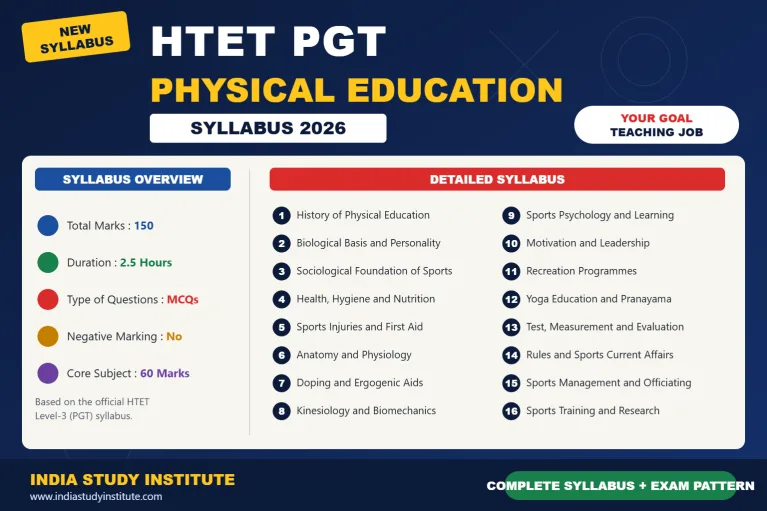
HTET PGT Physical Education Syllabus 2026
Physical Education is examined as an academic subject, and candidates from a sporting background are often caught out by how theoretical it is. Anatomy, physiology, biomechanics, sports psychology, yoga and training principles carry the sixty marks - practical experience helps you picture the content, but the questions come from the syllabus.
The complete official breakdown appears below, together with the ninety marks of common papers every Level-3 candidate answers and the full HTET 2026 exam pattern.
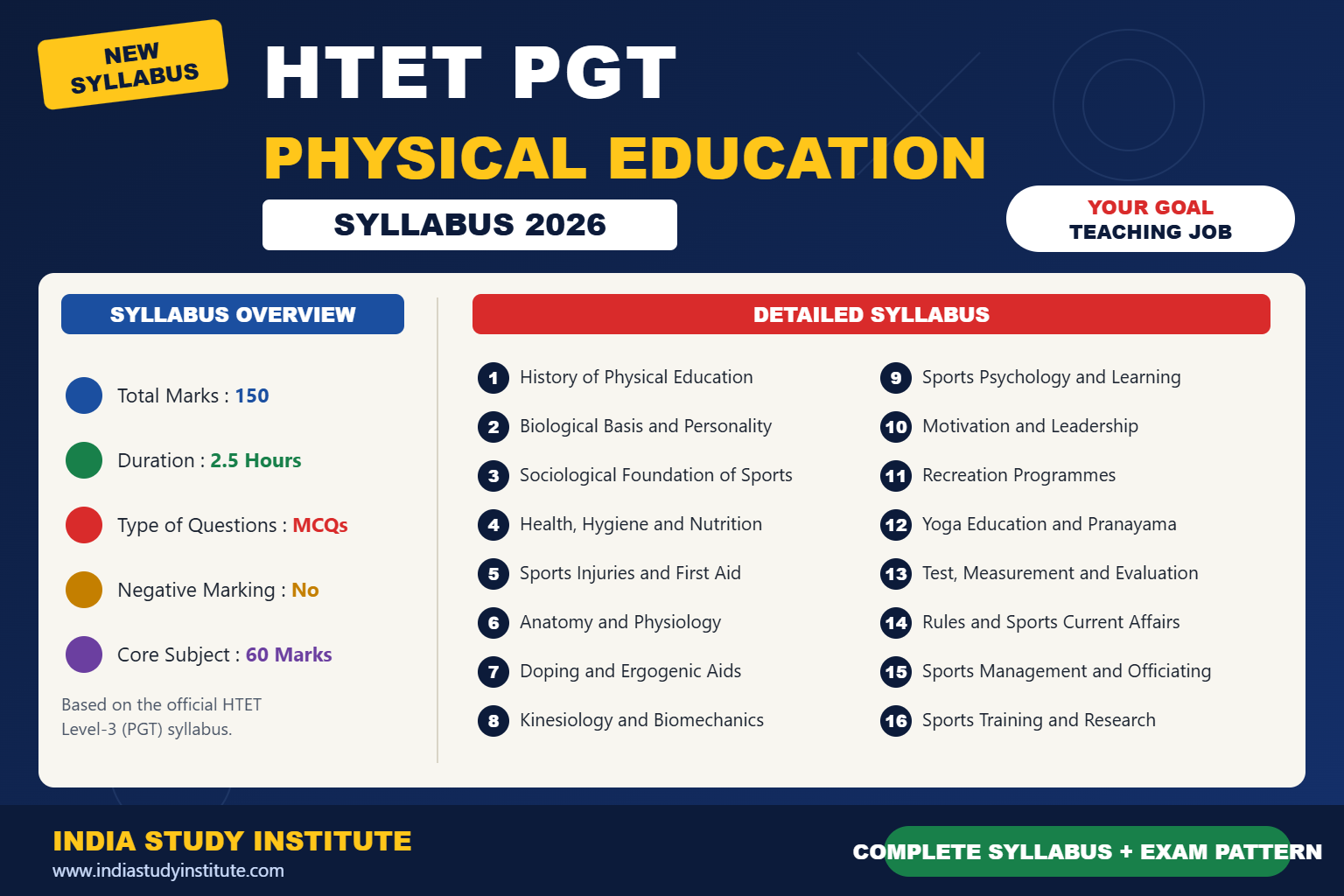
HTET PGT Physical Education Exam Pattern
Before the topics, get the structure straight. The paper is 150 multiple choice questions worth 150 marks, to be attempted in 2.5 hours. There is no negative marking, so leaving a question blank costs you the same as getting it wrong - attempt everything.
- Child Development and Pedagogy: 30 questions / 30 marks
- Languages (Hindi 15 and English 15): 30 questions / 30 marks
- General Studies (Quantitative Aptitude, Reasoning, Haryana GK): 30 questions / 30 marks
- Core Subject - Physical Education: 60 questions / 60 marks
- Total: 150 questions / 150 marks / 2.5 hours / no negative marking
Keep this HTET PGT Physical Education Syllabus 2026 breakdown open while you build your study plan. Each topic below appears in the official notification.
Part I: Common Subjects (90 Marks)
Every HTET Level-3 candidate answers the same 90 marks of common papers, whatever their teaching subject. This is where most candidates gain or lose their margin.
1. Child Development and Pedagogy (30 Marks)
This section tests your understanding of educational psychology as it applies to teaching senior secondary students.
- Child Development: Concept of development and its relationship with learning; principles of the development of children; influence of heredity and environment; socialization processes involving teachers, parents and peers.
- Key Theories: Piaget, Kohlberg and Vygotsky - constructs and critical perspectives; Freud's psychosexual development theory; Erikson's theory of psychosocial development; Bandura's social learning theory.
- Concepts and Intelligence: Child-centred and progressive education; critical perspective on the construct of intelligence; multi-dimensional intelligence; language and thought; gender as a social construct, gender roles and educational practice.
- Individual Differences: Understanding differences based on diversity of language, caste, gender, community and religion.
- Assessment: Distinction between assessment for learning and assessment of learning; school-based assessment; Continuous and Comprehensive Evaluation; formulating appropriate questions to assess readiness levels, enhance learning and critical thinking, and measure learner achievement.
- Inclusive Education: Understanding children with special needs; addressing learners from diverse, disadvantaged and deprived backgrounds; addressing children with learning difficulties and impairments; addressing talented, creative and specially abled learners.
- Learning and Pedagogy: How children think and learn, and why they sometimes fail to succeed in school; basic processes of teaching and learning; children's strategies of learning; learning as a social activity; the child as a problem solver and scientific investigator; understanding children's errors as significant steps in learning; cognition and emotions; motivation and learning; personal and environmental factors contributing to learning.
2. Languages (30 Marks)
The language paper is split evenly between Hindi and English, 15 marks each.
- Hindi (15 Marks): Reading an unseen passage from prose, drama or poetry with questions on comprehension, inference, grammar and verbal ability. Pedagogy of language development covering learning and acquisition, principles of language teaching, the role of listening and speaking, a critical perspective on the role of grammar, challenges of teaching language in a diverse classroom, language difficulties, errors and disorders, and teaching-learning materials.
- English (15 Marks): One unseen prose passage (discursive, literary, narrative or scientific) with questions on comprehension, grammar and verbal ability. Pedagogy of language development covering the same set of principles, plus textbooks, multi-media materials and multilingual resources of the classroom.
3. General Studies (30 Marks)
A composite section of three equal parts, testing aptitude, reasoning and state awareness.
- Quantitative Aptitude (10 Marks): Whole numbers, fractions and decimals, percentages, profit and loss, ratio and proportion, time and work, averages, basic algebra, geometry of triangles and circles, basic trigonometry, and interpretation of data graphs such as pie charts and histograms.
- Reasoning Ability (10 Marks): Verbal and non-verbal reasoning, analogies, space visualization, coding and decoding, syllogisms, Venn diagrams, pattern folding and unfolding, embedded figures, and social and emotional intelligence.
- Haryana General Knowledge and Awareness (10 Marks): State history, geography, civics, environment, regional culture, arts and traditions, current affairs, and active state welfare schemes.
Part II: Core Subject - Physical Education (60 Marks)
Questions are based on topics from the Class 9 to 12 syllabus prescribed by the Education Department of Haryana. The difficulty level, however, extends up to the post-graduate standard, so expect familiar topics to be tested at a much deeper conceptual level.
A) Foundations, Health & Anatomy
- Physical Education: History of physical education in India in the pre and post independence era.
- Biological Basis: Growth and development; heredity and environment; types of body; classification of personality (Kretschmer's and Sheldon's classification); dimensions of personality.
- Sociological Foundation: Sports and socialisation; role of institutions - family, society and school - towards participation in games and sports.
- Physical Education in Ancient Greece, Rome, Germany, Denmark, Sweden and Russia.
- Health and Hygiene: Guiding principles of health and health education; balanced diet and nutrition; health related fitness; obesity and its management; first aid.
- Communicable Diseases: Their causes and prevention.
- School health programme and personal hygiene; sports injuries and their prevention; postural deformities, their causes and prevention; sports medicine; physiotherapy and rehabilitation.
- Physical education and sports for children with special needs (CWSN) - Divyang; physical fitness and wellness.
- Anatomy and Physiology: Meaning and definition; anatomy and physiology of the respiratory system, blood circulatory system, skeletal system, muscular system, endocrine and exocrine systems, digestive system and nervous system (neuro-transmission); excretory system - organs, structure and functions.
B) Biomechanics, Sports Psychology & Yoga
- Ergogenic aids, doping and anti-doping; factors influencing performance in sports.
- Kinesiology and Biomechanics: Meaning and definition; joints and their movements; planes and axes; kinetics and kinematics - linear and angular; levers; muscular analysis of motor movement; laws of motion; principle of equilibrium; force; muscular analysis of various sports activities; mechanical analysis of fundamental movements - running, jumping, throwing, pulling and pushing.
- Psychology and Sociology in Sports: Meaning, definitions, aims and objectives.
- Learning: Learning process; theories of learning; laws of learning; transfer of learning.
- Motivation: Internal and external motivation; psychological factors affecting sports performance.
- Leadership: Meaning, definition and types; leadership qualities.
- Recreation: Theories and principles of recreation; recreation programmes for various age groups and categories.
- Yoga Education: History of yoga; meaning, definition, aims and objectives; Ashtanga yoga and its various parts; Surya Namaskar and its benefits; Pranayama - types and benefits; Shuddhi Kriyas - Neti, Dhoti, Basti; importance of yoga in daily life; yoga as a preventive measure for lifestyle diseases.
C) Test & Measurement, Sports Management & Training
- Test, Measurement and Evaluation: Concept and principles; skill tests for badminton, basketball, hockey, soccer, volleyball and lawn tennis; measurements in athletics (track and field events).
- Games and Sports: Major and minor games; rules and regulations of all games and sports; sports and games terminology; sports current affairs (India and world); sports and games federations; national and international games and the Olympic movement; cups and trophies; stadiums; tournaments and their fixtures; Khelo India and Fit India movements; ground marking for athletics and sports.
- Sports Management: Concept and principles of management; organisation and functions of sports bodies; intramural and extramural; management of infrastructure, equipment, finance and personnel; planning in sports; officiating; principles, methods and techniques of teaching; concept and techniques of supervision.
- Sports Training: Concept and principles of sports training; periodization; training methods; training programmes for development of various motor qualities; technical and tactical preparation; short term and long term training programmes.
- Media and sports; computer applications in physical education and sports; national sports awards.
- Research: Nature, scope and types of research; methods of research.
Subject-Related Pedagogy
The core paper also carries questions on the teaching of Physical Education itself: teaching strategies and methods, instructional tools and teaching aids, curriculum transaction, practical and activity based approaches, and assessment techniques appropriate to the senior secondary level.
How to Prepare for HTET PGT Physical Education 2026
- Start with the common 90 marks - they are identical every year and the fastest marks to secure.
- Work through the core syllabus in the A, B and C order given above; it moves from foundations and anatomy to biomechanics and yoga, and finally to measurement, management and training.
- Revise NCERT and Haryana Board textbooks first, then move to post-graduate level reference books for depth.
- Solve previous year HTET Level-3 papers to get used to the phrasing and the time pressure.
- Because there is no negative marking, practise attempting all 150 questions within 2.5 hours.
Official Notification & Practice Resources
Always cross-check the HTET PGT Physical Education Syllabus 2026 against the Board’s own notification before you finalise your plan. The syllabus is issued by the Board of School Education Haryana — visit the official BSEH website or read the HTET information bulletin (PDF).
The 90 common marks are the easiest place to gain ground on the HTET PGT Physical Education Syllabus 2026. Practise them here:
- Psychology Practice Set – for Child Development & Pedagogy
- Hindi Grammar Practice Set
- English Grammar Practice Set
- Reasoning Practice Set
- Mathematics Practice Set
- Haryana GK Practice Set
Other HTET PGT Level-3 syllabus guides: Physics, Chemistry, Biology, Mathematics, Commerce, Economics, English and Computer Science.
Bookmark this page - we update this HTET PGT Physical Education Syllabus 2026 guide whenever the Board of School Education Haryana (BSEH) revises the official syllabus or releases a new notification.


0 Comments
Be the first to comment.
Leave a comment
Your email will not be published. Comments are reviewed before appearing.