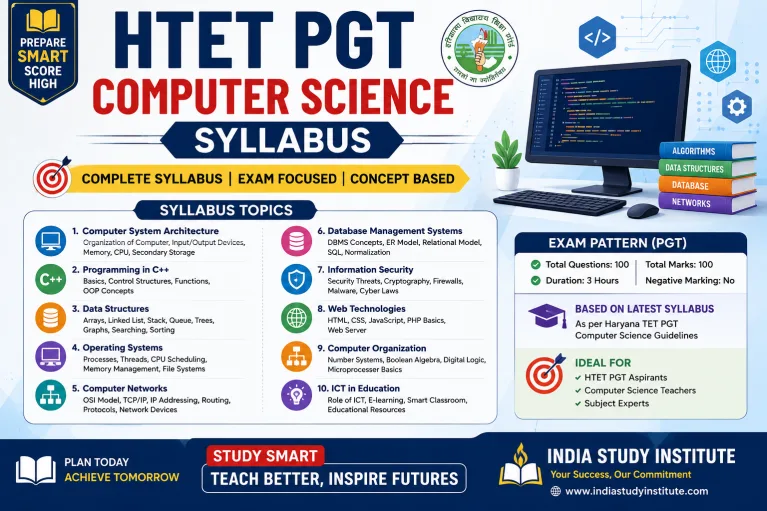
HTET PGT Computer Science Syllabus 2026: Complete Syllabus & Exam Pattern
Before starting reading about HTET PGT Computer Science Syllabus 2026, we have to know about the What is HTET? Why we need to attend HTET exam?
HTET is a Teaching exam which is conducted by Haryana Government every year. There are three level in this exam. Level-I for primary school teacher, and this is also known as PRT. After this there is Level-II exam. This exam is also known as TGT (Trained Graduate Teacher) who teaches students from class 6th to class 10th students. And the last Level-III (PGT Level), which is known as Post Graduate Teacher. These teachers teach only 11th and 12th standard students.
The Computer Science paper sits slightly apart from the rest of HTET Level-3. Where most subjects reward wide reading, this one rewards precision: a question on pointer arithmetic or normal forms has exactly one defensible answer, and partial understanding shows up immediately in the score.
That makes the syllabus unusually useful as a planning document. Sixty marks come from core Computer Science - fundamentals, C and C++, data structures, operating systems, DBMS, networks, web technologies, software engineering, digital electronics, information security and ICT in education. The other ninety are shared with every Level-3 candidate. Below is the full official breakdown of both halves, plus the exam pattern the Board has notified for 2026.
Other Subjects Syllabus PGT:
- HTET PGT Hindi Syllabus 2026
- HTET PGT English Syllabus 2026
- HTET PGT Punjabi Syllabus 2026
- HTET PGT SANSKRIT Syllabus 2026
- HTET PGT History Syllabus 2026
- HTET PGT POLITICAL SCIENCE Syllabus 2026
- HTET PGT ECONOMICS Syllabus 2026
- HTET PGT GEOGRAPHY Syllabus 2026
- HTET PGT HOME SCIENCE Syllabus 2026
- HTET PGT COMMERCE Syllabus 2026
- HTET PGT SOCIOLOGY Syllabus 2026
- HTET PGT PHYSICAL EDUCATION Syllabus 2026
- HTET PGT PSYCHOLOGY Syllabus 2026
- HTET PGT CHEMISTRY Syllabus 2026
- HTET PGT BIOLOGY Syllabus 2026
- HTET PGT MATHEMATICS Syllabus 2026
- HTET PGT MUSIC Syllabus 2026
- HTET PGT FINE ART Syllabus 2026
- HTET PGT COMPUTER SCIENCE Syllabus 2026
- HTET PGT PHYSICS Syllabus 2026
- HTET PGT URDU Syllabus 2026
HTET PGT Exam Pattern at a Glance
The mark distribution is worth fixing in your head before you look at the topics. The exam consists of 150 Multiple Choice Questions (MCQs) worth 150 marks, with a duration of 2.5 hours and no negative marking:
HTET Exam Pattern 2026 [Level 1] | |||
| Subject | Questions | Marks | |
| Child Development and Pedagogy | 30 | 30 | |
| Language-Hindi | 15 | 15 | |
| Language-English | 15 | 15 | |
| Quantitative aptitude | 10 | 10 | |
| Reasoning | 10 | 10 | |
| Haryana GK | 10 | 10 | |
| Common Subjects (Total Marks) | 90 | 90 | |
| Core Subject (Computer Science) | 60 | 60 | |
| Total | 150 | 150 | |
| Child Development and Pedagogy: | 30 Questions | 30 Marks |
| Languages (Hindi 15 & English 15): | 30 Questions | 30 Marks |
| General Studies (Quant, Reasoning, Haryana GK): | 30 Questions | 30 Marks |
| Core Computer Science Subject: | 60 Questions | 60 Marks |
Part 1: Common Subjects Syllabus (90 Marks)
Securing high scores in the common section is the secret to clearing the cut-off. Here are the mandatory sections every candidate must prepare.
1. Child Development & Psychology (30 Marks)
This section evaluates your understanding of educational psychology tailored to teaching adolescents (ages 14–17). HTET Child Development and Psychology practice questions for complete notes
- Child Development: Concepts of development and its relationship with learning; principles of child development; and the influence of Heredity & Environment.
- Key Theories: Critical perspectives of Piaget, Kohlberg, and Vygotsky; Freud's Psychosexual Development Theory; Erikson's Psychosocial Theory; and Bandura's Social Learning Theory.
- Inclusive Education: Addressing diverse learners, socioeconomic disadvantages, learning disabilities, and nurturing gifted/specially-abled children.
- Learning & Pedagogy: How children think and learn; motivation; alternative conceptions of learning; assessing children’s "errors" as cognitive steps; and Continuous & Comprehensive Evaluation (CCE) frameworks.
2. Language Proficiency (30 Marks)
Split evenly between Hindi and English, this tests your foundational linguistic control and pedagogy for HTET PGT Computer Science Syllabus 2026.
- Hindi Language (15 Marks): Unseen passages assessing comprehension, inferences, and verbal ability. Structural grammar, pedagogical principles of language teaching, handling diverse classrooms, and language disorders. Hindi Grammar question bank to read and practice all the questions related to HTET PGT Computer Science.
- English Language (15 Marks): Unseen prose passages (literary, scientific, or narrative) testing comprehension, grammar, and vocabulary. Pedagogy of language acquisition, speech-listening mechanics, structural syntax, and standard teaching aids. English Grammar question bank for English.
3. General Studies (30 Marks)
A composite section designed to test your mental aptitude and local awareness for HTET PGT Computer Science Syllabus 2026.
- Quantitative Aptitude (10 Marks): Whole numbers, fractions, decimals, percentages, profit & loss, ratio & proportion, time & work, averages, basic algebra, geometry (triangles, circles), basic trigonometry, and data graphs (pie charts, histograms).
- General Intelligence & Reasoning (10 Marks): Verbal and non-verbal reasoning, analogies, space visualization, coding & decoding, syllogisms, Venn diagrams, pattern folding/unfolding, embedded figures, and social/emotional intelligence.
- Haryana GK and Awareness (10 Marks): Local state history, geography, civics, environment, regional culture, arts, traditions, current affairs, and active state welfare schemes.
Part 2: Core Subject – Computer Science (60 Marks) - HTET PGT Computer Science Syllabus 2026
The major weightage relies heavily on this section. While the framework aligns with standard senior secondary subjects (Classes 9–12), the official bulletin warns that the difficulty standard can stretch up to the Post-Graduate level.
1. Computer Systems, Architecture & Office Automation
- Foundations: Systems history, computer generations, CPU components (ALU, CU), and peripheral input/output architectures.
- Memory & Data: Memory storage hierarchies, measurement units, number system conversions (Binary, Octal, Hexadecimal), and encoding standards like ASCII and UNICODE.
- Software Ecosystems: System software (OS tasks, assemblers, compilers, interpreters), utility tools, device drivers, and standard Windows environment workflows.
- Office Productivity (MS Office):
- MS Word: Formatting, layout properties, indents, borders, tables, and headers/footers.
- MS Excel: Cells, referencing types, advanced charting components, data formulas, and built-in execution tools like Sum(), Average(), Max(), Min(), and Count().
2. Software Engineering, Programming Essentials & Cyber Security
- Systems Engineering & SDLC: Traditional Software Development Life Cycle models (feasibility study, analysis, design, deployment); problem-solving matrices using logic flowcharts.
- Testing Methodologies: Testing frameworks (Black-box vs. White-box systems) and functional levels (Unit, Integration, System, and Acceptance testing paradigms).
- Python Programming Fundamentals:
- Syntax modes, operators, token definitions, data type casting, and operator precedence architectures.
- Flow execution control structures (sequential loops, selections) alongside modular user-defined functions.
- Mastering primary structures: Strings, Lists, Tuples, and Dictionaries (evaluating properties, mutability, and key-value methods).
- Web Engineering (HTML): Document structures, semantic text formatting tags, hyperlink embedments, dynamic tables, components, and interactive containers.
- Emerging Technologies & Trends: Core landscapes of Artificial Intelligence (AI), Machine Learning (ML), Natural Language Processing (NLP), Big Data Analytics, Cloud/Grid structures, Internet of Things (IoT), and 5G networks.
- Cyber Security & Laws: Analyzing malicious scripts (Viruses, Trojans, Worms, Adware, Ransomware); identity safety rules, intellectual property rights (IPR), digital footprints, and implementation of the Indian IT Act.
3. Databases, Networking & Object-Oriented Structures
- Database Management Systems (DBMS): Traditional file layouts vs. structural databases; transactional normalizations and execution of fundamental normal forms.
- MS Access Applications: Structural data types, relational schemas, primary keys, table definitions using Datasheet or Design view options, and validation criteria settings.
- Structured Query Language (SQL): Standard data types, execution of DDL and DML commands, aggregate function rules, and relational clauses.
- Data Communication & Computer Networks: Transmission properties (guided vs. unguided media), LAN/WAN layouts, network topologies, reference models, and standard protocol stacks.
- Internet Systems & Web Services: Server infrastructures, firewalls, search engine crawling mechanics, URL parsing, video conferencing setups, and baseline application layer protocols (TCP/IP, FTP, TELNET, SMTP, HTTP, HTTPS, POP3).
- Object-Oriented Programming (OOP) via C++:
- Paradigms of data encapsulation, abstraction, multi-level inheritance, and polymorphism.
- Classes and objects, structural variables, visibility modes (private/public), scope resolution (::), constructor/destructor behavior, and friend functions.
- Advanced Data Structures: Logic implementation behind sequential storage layouts, abstract stacks (Push/Pop operations), queues (Insertion/Deletion constraints), and basic array sorting algorithms.
Download Complete Syllabus PDF Here
Visit Official Website for more information
Practice Sets for common subjects:
- Psychology MCQ Questions for practice
- Hindi Grammar MCQ Questions for practice
- English Grammar MCQ Questions for practice
- Reasoning MCQ Questions for practice
- Mathematic MCQ Questions for practice
- Haryana GK MCQ Questions for practice questions
Practice Sets for Core Subject:
Strategy Tips to Ace the Exam - HTET PGT Computer Science Syllabus 2026
- Prioritize the Core Subject: Computer Science holds 40% of the weightage. Dedicate focused time to writing code logic in C++ and Python, as well as solving networking numeric questions.
- Stay Updated on Haryana GK: For the General Studies section, regularly read up on Haryana’s recent budgetary allocations, welfare schemes, and cultural updates.
- Practice Without Negative Marking: Since there is no negative marking, practice elimination strategies during mock exams to maximize your attempts.
Disclaimer: Kindly visit the official website and recheck syllabus for the given post to know more about HTET PGT Computer Science Syllabus 2026

0 Comments
Be the first to comment.
Leave a comment
Your email will not be published. Comments are reviewed before appearing.