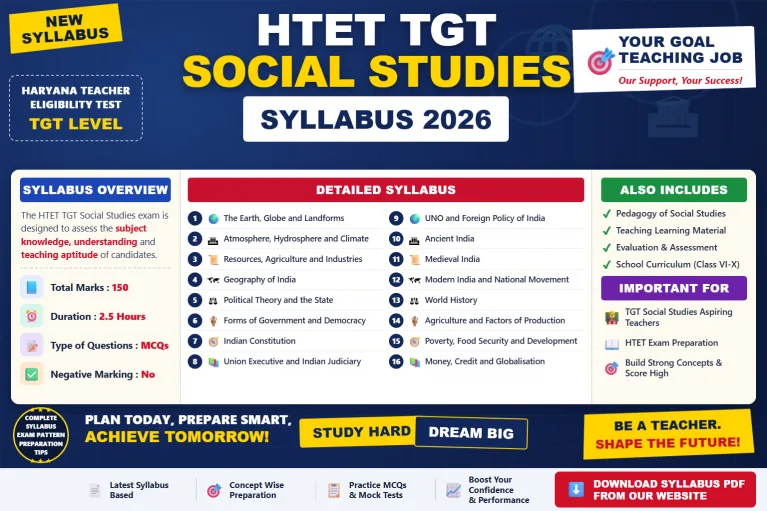
HTET TGT Social Studies Syllabus 2026
Social Studies carries the widest brief of any Level-2 subject. History, Geography, Political Science and Economics all feed the same sixty-mark section, which means the real difficulty is not depth but coverage - four disciplines competing for the same preparation hours.
Below is the official Board syllabus for all four strands, alongside the ninety marks of common papers shared across every Level-2 subject and the full HTET 2026 exam pattern.
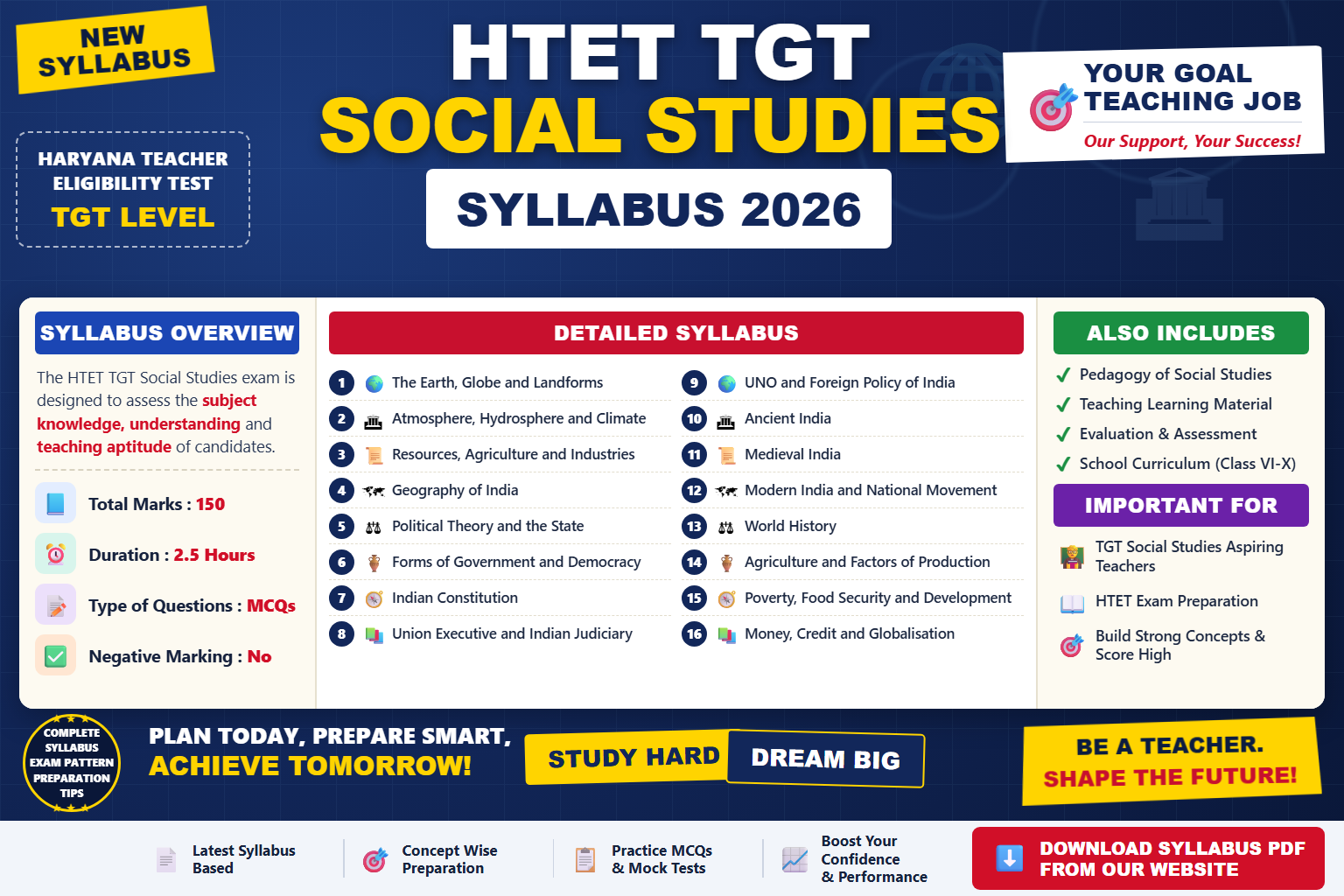
HTET TGT Social Studies Exam Pattern at a Glance - HTET TGT Social Studies Syllabus 2026
Look at the mark split before the syllabus itself. HTET Level-2 has only one paper of 150 Multiple Choice Questions (MCQs) carrying 150 marks, with a duration of two-and-a-half hours and no negative marking. Each question has four alternatives, out of which one is correct.
| Section | No. of MCQs | Marks |
|---|---|---|
| Child Development and Pedagogy | 30 | 30 |
| Languages (Hindi 15 & English 15) | 30 | 30 |
| General Studies (Quantitative Aptitude 10, Reasoning Ability 10, Haryana G.K. 10) | 30 | 30 |
| Subject Specific – Social Studies | 60 | 60 |
| Total | 150 | 150 |
The qualifying mark is 60% (90 marks) for all categories, and 55% (82 marks) for Scheduled Castes and Differently Abled/Physically Challenged candidates of Haryana.
Part 1: Common Subjects Syllabus (90 Marks) - HTET TGT Social Studies Syllabus 2026
Securing high scores in the common section is the secret to clearing the cut-off. Because these sections do not change between subjects, they reward early preparation.
1. Child Development and Pedagogy (30 Marks)
This section focuses on the educational psychology of teaching and learning relevant to the age group of 11–16 years. HTET Child Development and Psychology practice questions.
- Child Development: Concept of development and its relationship with learning, principles of the development of children, influence of Heredity & Environment.
- Socialization Processes: Social world & children – teacher, parents and peers.
- Key Theories: Piaget, Kohlberg and Vygotsky – constructs and critical perspectives.
- Concepts: Child-centred and progressive education; critical perspective of the construct of Intelligence; Multi-Dimensional Intelligence; Language & Thought.
- Gender & Diversity: Gender as a social construct, gender roles, gender bias and educational practice; individual differences among learners based on diversity of language, caste, gender, community and religion.
- Assessment: Distinction between assessment for learning and assessment of learning; School-Based Assessment; Continuous & Comprehensive Evaluation; formulating appropriate questions for assessing readiness levels and critical thinking.
- Inclusive Education: Understanding children with special needs, learners from disadvantaged and deprived backgrounds, children with learning difficulties and impairment, and addressing talented, creative and specially abled learners.
- Learning & Pedagogy: How children think and learn; why children “fail” to achieve success; basic processes of teaching and learning; learning as a social activity; child as a problem solver and “scientific investigator”; understanding children’s “errors” as significant steps in learning; cognition & emotions; motivation; personal and environmental factors contributing to learning.
2. Language Proficiency (30 Marks)
Split evenly between Hindi and English, this part tests your foundational linguistic control and language pedagogy.
- Language I – Hindi (15 Marks): One unseen passage from prose, drama or poetry with questions on comprehension, inference, grammar and verbal ability. Practise the Hindi Grammar question bank here.
- Language II – English (15 Marks): One unseen prose passage (discursive, literary, narrative or scientific) with questions on comprehension, grammar and verbal ability. Practise the English Grammar question bank here.
- Pedagogy of Language Development (both languages): Learning and acquisition; principles of language teaching; role of listening and speaking and how children use language as a tool; critical perspective on the role of grammar; challenges of teaching language in a diverse classroom; language difficulties, errors and disorders; language skills.
- Teaching-Learning Materials: Textbook, multi-media materials and multilingual resources of the classroom.
3. General Studies (30 Marks)
A composite section designed to test your mental aptitude and awareness of Haryana.
- Haryana G.K. and Awareness (10 Marks): Haryana related history, current affairs, literature, geography, civics, environment, culture, art, traditions and welfare schemes of the Haryana Government. Attempt the Haryana GK practice set.
- General Intelligence & Reasoning (10 Marks): Semantic, symbolic/number and figural analogy; classification; series; problem solving; word building; coding & decoding; numerical and symbolic operations; trends; space orientation and visualization; Venn diagrams; drawing inferences; punched hole and pattern folding/unfolding; figural pattern folding and completion; indexing; address matching; date & city matching; embedded figures; critical thinking; emotional and social intelligence. Solve the Reasoning practice set.
- Quantitative Aptitude (10 Marks): Whole numbers, decimals, fractions and relationships between numbers; percentage; ratio & proportion; square roots; averages; interest; profit and loss; discount; partnership business; mixture and allegation; time and distance; time & work; basic algebraic identities and elementary surds; graphs of linear equations; triangle and its various kinds of centres; congruence and similarity of triangles; circle and its chords and tangents; quadrilaterals; regular polygons; right prism, right circular cone and cylinder, sphere, hemispheres, rectangular parallelepiped and regular right pyramid; trigonometric ratios; degree and radian measures; standard identities; complementary angles; heights and distances; histogram, frequency polygon, bar diagram & pie chart. Practise the Mathematics question bank.
Part II: Core Subject – Social Studies (60 Marks)
Questions are based on the topics of the syllabus prescribed by the Board of School Education Haryana for classes VI to X, but their difficulty level and conceptual linkages can extend up to the senior secondary stage. Social Studies is the widest Level-2 subject, drawing on four distinct disciplines.
A) Geography
- General Geography: Geography as a social study, the Solar System, the Earth and its motions, globe, latitudes and longitudes, major spheres of the Earth.
- Physical Geography: Inside our Earth – layers and rocks; mountains, plateaus, plains, volcanoes and earthquakes; development of landforms and the various agents and processes.
- Atmosphere and Hydrosphere: Composition, structure, air pressure, winds, precipitation and climatic regions; hydrosphere and its importance, tides and ocean currents.
- Environment: Concept, ecosystem, pollution, hazards and disasters, human–environment interactions.
- Resources: Land, soil, water, natural vegetation and wildlife resources; agriculture – types, methods, major crops and developments; industries – classification and distribution; human resource; maps and their types.
- Geography of India: Size and location, physiography and physical structure, drainage, climate and monsoon, natural vegetation and wildlife, water resources, agriculture and major crops with their distribution and related problems, minerals and energy resources, major manufacturing industries, lifelines of the national economy.
B) Political Science and Civics
- Political Theory: Nature, scope and significance of political theory; state – elements and theories of its origin, nature and functions; sovereignty, liberty, equality, justice, rights, citizenship, nationalism, secularism, consumer protection rights, feminism.
- Forms of Government: Democratic and dictatorship, parliamentary and presidential, unitary and federal.
- Democracy: Concept, types, theories and methods of representation, popular struggles and movements for democracy; challenges to democracy – inequality, poverty, illiteracy, linguism, regionalism, communalism, casteism, separatism, political violence, national integration, gender issues and marginalisation.
- Indian Constitution: Constitutional development and the making of the Constitution, sources, features, Preamble, Fundamental Rights and Duties, Directive Principles of State Policy.
- Government Machinery: Union Executive – President, Vice President, Prime Minister and Council of Ministers; Union Legislature – composition, law-making and amendment procedure; State legislature; Indian judiciary – Supreme Court, High Court, judicial review, PIL, Right to Information Act, federalism, Panchayati Raj and the 73rd Amendment, Election Commission and electoral reforms, party system, coalition government and politics of reservation.
- International Relations: Origin and evolution of the UNO, its organs and specialised agencies, role of the Security Council and Secretary General; Foreign Policy of India – basic principles, relations with neighbours, USA and Russia, Cold War and post-Cold War era, NAM, European Union, SAARC, ASEAN, WTO, IMF, World Bank, disarmament and globalisation.
C) History
- Ancient India: Sources, prehistoric civilization from hunter-gatherer to the Neolithic revolution, Harappan Civilization, religious trends – Vedic, Buddhism and Jainism, Mahajanapada period, Mauryan Empire, foreign invaders, post-Mauryan states, southern states – Chalukyas, Pallavas and Cholas, trade and urbanisation, Gupta and Vardhana empires, art and architecture.
- Medieval India: Sources (700 AD to 1750 AD), early medieval dynasties, the tripartite struggle, Palas, Pratiharas and Rashtrakutas, Prithvi Raj Chauhan, Delhi Sultanate and Mughals, Vijayanagar Empire, Chhatrapati Shivaji and the Marathas, socio-religious movements – Bhakti, Sufi and the tradition of Sikh Gurus, medieval art, architecture and literature.
- Modern India: Sources, India in the 18th century, European companies and their conflicts, changes in the land revenue system, Revolution of 1857, Indian Renaissance, British education policy, colonisation and its effect on indigenous industry, rise of nationalism, Indian National Movement (1885–1947), role of Gandhi Ji and Netaji, Independence and Partition, framing of the Constitution, role of Haryana in the national movement.
- World History: Human evolution, prehistoric man, rise of Islam and the Caliphate, Confucianism, Genghis Khan and the Mongol Empire, feudalism in Europe, role of the Church, European Renaissance, colonisation and imperialism.
D) Economics
- Agriculture: Role of agriculture in India, agricultural development during the Five Year Plans, farm products and non-farm activities.
- Factors of Production: Land, labour, capital and entrepreneur, human capital, theories of rent, wages, interest and profit, unemployment and its trends in India.
- Poverty and Food Security: Types, measurement, causes, inter-state disparities, poverty estimation and anti-poverty schemes; food security, Green Revolution, Public Distribution System, buffer stocks and the pillars of food security.
- Development: Economic growth, economic development and sustainable development, measurement of development – HDI, HPI, PQLI and hunger index; sectors of the Indian economy – primary, secondary and tertiary, organised and unorganised, public and private.
- Money, Credit and Globalisation: Meaning and functions of money, modern forms of money, commercial banks, RBI and its functions, credit creation, money multiplier, formal and informal credit; New Economic Policy – liberalisation, privatisation and globalisation, WTO, consumer rights and COPRA 1986.
- Micro Economics: Utility analysis – cardinal and ordinal utility, indifference curve analysis; demand analysis – law of demand, factors affecting demand and elasticity of demand.
E) Subject-Related Pedagogy
- Nature and scope of Social Studies, aims and objectives of teaching Social Studies at the upper primary and secondary level.
- Methods and approaches of teaching, project and source-based learning, use of maps, timelines and case studies.
- Teaching-learning material, social science laboratory, field visits and the use of ICT in the classroom.
- Evaluation and assessment in Social Studies, developing critical thinking and constitutional values.
How to Prepare for the HTET TGT Social Studies Syllabus 2026
Questions in Level-2 are set on the topics prescribed by the Board of School Education Haryana for classes VI to X, but their difficulty and conceptual linkages can extend up to the senior secondary stage. Plan accordingly.
- Start with the BSEH/NCERT textbooks of classes VI–X for Social Studies and build your notes chapter-wise before touching any guidebook.
- Child development, languages and general studies repay steady work more than the subject paper does.
- Revise Haryana G.K. and current affairs weekly; this is the section most candidates leave until it is too late.
- Time your mocks properly - 150 questions in two and a half hours.
- Solve previous year HTET Level-2 Social Studies papers to understand the question style and the recurring topics.
- The teaching-methods questions reward preparation out of proportion to their difficulty.
Official Notification and Useful Links - HTET TGT Social Studies Syllabus 2026
Always cross-check the syllabus with the official bulletin before you begin. The Board of School Education Haryana publishes the HTET notification, syllabus and sample papers on its official portal.
- Official BSEH website: bseh.org.in
- HTET previous year question papers (Level-II): Download the Social Studies sample paper
Other Important Links:

0 Comments
Be the first to comment.
Leave a comment
Your email will not be published. Comments are reviewed before appearing.