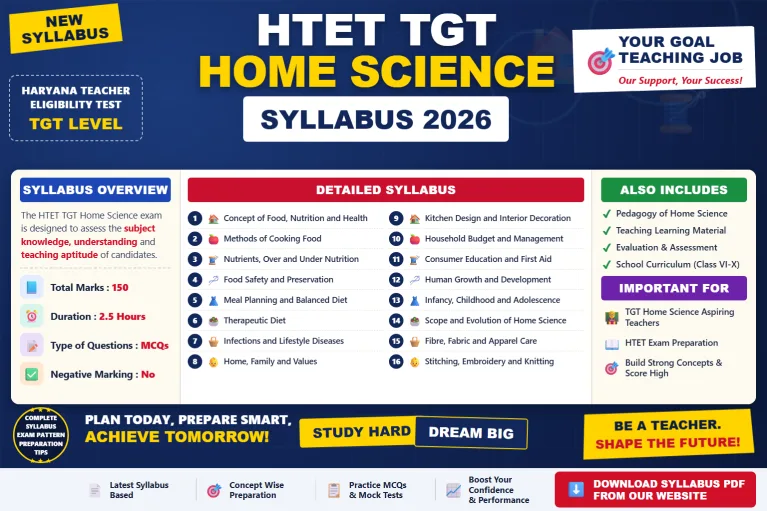
HTET TGT Home Science Syllabus 2026
Home Science covers more ground than its name suggests - food and nutrition, human development, textiles, resource management and communication all appear within the same sixty marks. It is a genuinely interdisciplinary paper, and preparation tends to fail at whichever strand a candidate assumed was minor.
The official Board syllabus is set out below in full, together with the ninety marks of common papers every Level-2 candidate answers and the exam pattern notified for 2026.
HTET TGT Home Science Exam Pattern at a Glance - HTET TGT Home Science Syllabus 2026
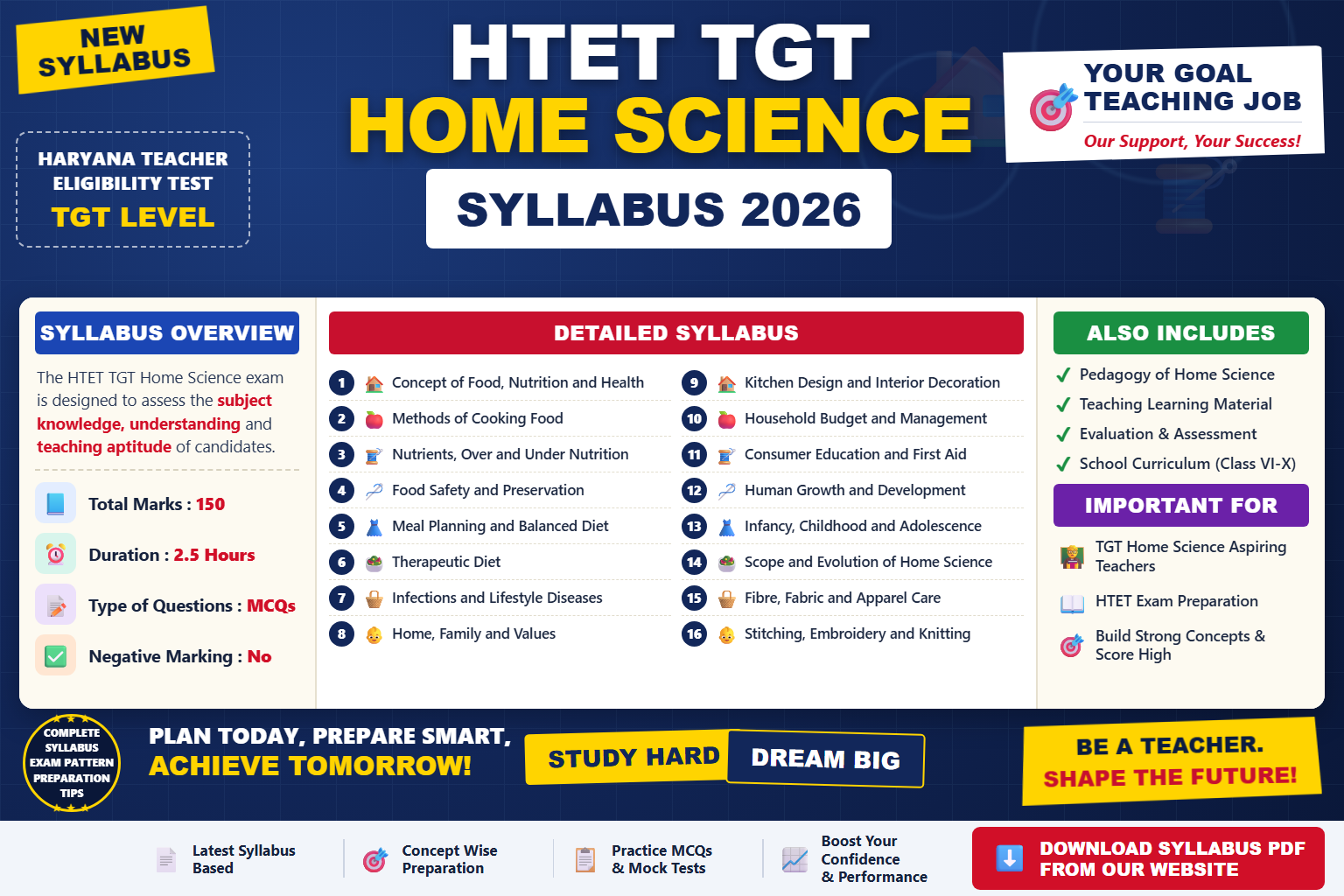
Start with how the marks are split - it shapes everything that follows. HTET Level-2 has only one paper of 150 Multiple Choice Questions (MCQs) carrying 150 marks, with a duration of two-and-a-half hours and no negative marking. Each question has four alternatives, out of which one is correct.
| Section | No. of MCQs | Marks |
|---|---|---|
| Child Development and Pedagogy | 30 | 30 |
| Languages (Hindi 15 & English 15) | 30 | 30 |
| General Studies (Quantitative Aptitude 10, Reasoning Ability 10, Haryana G.K. 10) | 30 | 30 |
| Subject Specific – Home Science | 60 | 60 |
| Total | 150 | 150 |
The qualifying mark is 60% (90 marks) for all categories, and 55% (82 marks) for Scheduled Castes and Differently Abled/Physically Challenged candidates of Haryana.
Part 1: Common Subjects Syllabus (90 Marks) - HTET TGT Home Science Syllabus 2026
Securing high scores in the common section is the secret to clearing the cut-off. This block is common to every Level-2 paper, which makes it predictable ground.
1. Child Development and Pedagogy (30 Marks)
This section focuses on the educational psychology of teaching and learning relevant to the age group of 11–16 years. HTET Child Development and Psychology practice questions.
- Child Development: Concept of development and its relationship with learning, principles of the development of children, influence of Heredity & Environment.
- Socialization Processes: Social world & children – teacher, parents and peers.
- Key Theories: Piaget, Kohlberg and Vygotsky – constructs and critical perspectives.
- Concepts: Child-centred and progressive education; critical perspective of the construct of Intelligence; Multi-Dimensional Intelligence; Language & Thought.
- Gender & Diversity: Gender as a social construct, gender roles, gender bias and educational practice; individual differences among learners based on diversity of language, caste, gender, community and religion.
- Assessment: Distinction between assessment for learning and assessment of learning; School-Based Assessment; Continuous & Comprehensive Evaluation; formulating appropriate questions for assessing readiness levels and critical thinking.
- Inclusive Education: Understanding children with special needs, learners from disadvantaged and deprived backgrounds, children with learning difficulties and impairment, and addressing talented, creative and specially abled learners.
- Learning & Pedagogy: How children think and learn; why children “fail” to achieve success; basic processes of teaching and learning; learning as a social activity; child as a problem solver and “scientific investigator”; understanding children’s “errors” as significant steps in learning; cognition & emotions; motivation; personal and environmental factors contributing to learning.
2. Language Proficiency (30 Marks)
Split evenly between Hindi and English, this part tests your foundational linguistic control and language pedagogy.
- Language I – Hindi (15 Marks): One unseen passage from prose, drama or poetry with questions on comprehension, inference, grammar and verbal ability. Practise the Hindi Grammar question bank here.
- Language II – English (15 Marks): One unseen prose passage (discursive, literary, narrative or scientific) with questions on comprehension, grammar and verbal ability. Practise the English Grammar question bank here.
- Pedagogy of Language Development (both languages): Learning and acquisition; principles of language teaching; role of listening and speaking and how children use language as a tool; critical perspective on the role of grammar; challenges of teaching language in a diverse classroom; language difficulties, errors and disorders; language skills.
- Teaching-Learning Materials: Textbook, multi-media materials and multilingual resources of the classroom.
3. General Studies (30 Marks)
A composite section designed to test your mental aptitude and awareness of Haryana.
- Haryana G.K. and Awareness (10 Marks): Haryana related history, current affairs, literature, geography, civics, environment, culture, art, traditions and welfare schemes of the Haryana Government. Attempt the Haryana GK practice set.
- General Intelligence & Reasoning (10 Marks): Semantic, symbolic/number and figural analogy; classification; series; problem solving; word building; coding & decoding; numerical and symbolic operations; trends; space orientation and visualization; Venn diagrams; drawing inferences; punched hole and pattern folding/unfolding; figural pattern folding and completion; indexing; address matching; date & city matching; embedded figures; critical thinking; emotional and social intelligence. Solve the Reasoning practice set.
- Quantitative Aptitude (10 Marks): Whole numbers, decimals, fractions and relationships between numbers; percentage; ratio & proportion; square roots; averages; interest; profit and loss; discount; partnership business; mixture and allegation; time and distance; time & work; basic algebraic identities and elementary surds; graphs of linear equations; triangle and its various kinds of centres; congruence and similarity of triangles; circle and its chords and tangents; quadrilaterals; regular polygons; right prism, right circular cone and cylinder, sphere, hemispheres, rectangular parallelepiped and regular right pyramid; trigonometric ratios; degree and radian measures; standard identities; complementary angles; heights and distances; histogram, frequency polygon, bar diagram & pie chart. Practise the Mathematics question bank.
Part II: Core Subject – Home Science (60 Marks)
Questions are based on the topics of the syllabus prescribed by the Board of School Education Haryana for classes VI to X, but their difficulty level and conceptual linkages can extend up to the senior secondary stage. The 60-mark paper is organised into three divisions.
A) Food, Nutrition and Health
- Basic Concepts: Concept of food, nutrition and health; types and functions of food.
- Cooking: Importance and methods of cooking food, and the nutrients of food.
- Nutrition: Concept of nutrition, over-nutrition and under-nutrition.
- Food Safety: Food safety, food storage and food preservation; food and personal hygiene and cleanliness.
- Meal Planning: Concept, importance, principles and the factors affecting it; balanced diet and therapeutic diet.
- Kitchen Practice: Weights and measures commonly used in the kitchen.
- Health: Infections and lifestyle diseases.
B) Home Management and Resource Management
- Home, Family and Values: Concept and importance; types of rooms in a house.
- Interiors: Lighting and ventilation in a house, kitchen design and layout, decoration of walls, dining table arrangements, flower arrangements, furniture choice and selection, and the use of colours in various areas of a house.
- Household Routine: Our behaviour, household routine, the patient’s room in a house, floor decoration, disposal of waste and cleaning in a house.
- Family Finance: Expenses of an average Indian household; budget – concept, types and advantages.
- Management: Management in daily life; management of resources – time, energy and money; work simplification techniques.
- Consumer and Safety: Consumer education, safety and management in emergency situations, pesticides and first aid in the house.
C) Human Development and Textiles
- Growth and Development: Concept, similarities and differences between growth and development, factors affecting them and the principles underlying growth and development.
- Stages of Development: Infancy, childhood and adolescence – concept, special features/characteristics and the milestones of each stage.
- The Discipline: Concept of Home Science – its evolution, fields and sub-disciplines, relevance, career and scope.
- Apparel: Our apparel and the selection of clothes; fibre and fabric – types, characteristics and classification of fibres.
- Fabric Care: Care and maintenance of fabrics and apparel (especially cotton, wool, silk and synthetics), cleaning of clothes, equipment used in cleaning clothes, and cleaning and finishing agents used in routine care.
- Needlework: The art of knitting, basic stitches used in stitching and embroidery, beautifying the apparel, and warp and weft.
D) Subject-Related Pedagogy
- Aims and objectives of teaching Home Science at the upper primary and secondary level.
- Methods and approaches of teaching – demonstration, project, laboratory and practical work.
- Teaching-learning material, the Home Science laboratory, and the use of ICT in the classroom.
- Evaluation and assessment in Home Science, including practical and continuous assessment.
How to Prepare for the HTET TGT Home Science Syllabus 2026
Questions in Level-2 are set on the topics prescribed by the Board of School Education Haryana for classes VI to X, but their difficulty and conceptual linkages can extend up to the senior secondary stage. Plan accordingly.
- Start with the BSEH/NCERT textbooks of classes VI–X for Home Science and build your notes chapter-wise before touching any guidebook.
- The common sections are where preparation converts most reliably into marks.
- Revise Haryana G.K. and current affairs weekly; this is the section most candidates leave until it is too late.
- Practise at full length and full speed, not in short bursts.
- Solve previous year HTET Level-2 Home Science papers to understand the question style and the recurring topics.
- Pedagogy questions are among the more approachable on the paper - do not skip them.
Official Notification and Useful Links - HTET TGT Home Science Syllabus 2026
Always cross-check the syllabus with the official bulletin before you begin. The Board of School Education Haryana publishes the HTET notification, syllabus and sample papers on its official portal.
- Official BSEH website: bseh.org.in
- HTET previous year question papers (Level-II): Download the Home Science sample paper
Other Important Links:

0 Comments
Be the first to comment.
Leave a comment
Your email will not be published. Comments are reviewed before appearing.