Reasoning - Odd One Out: 18 MCQs with Answers
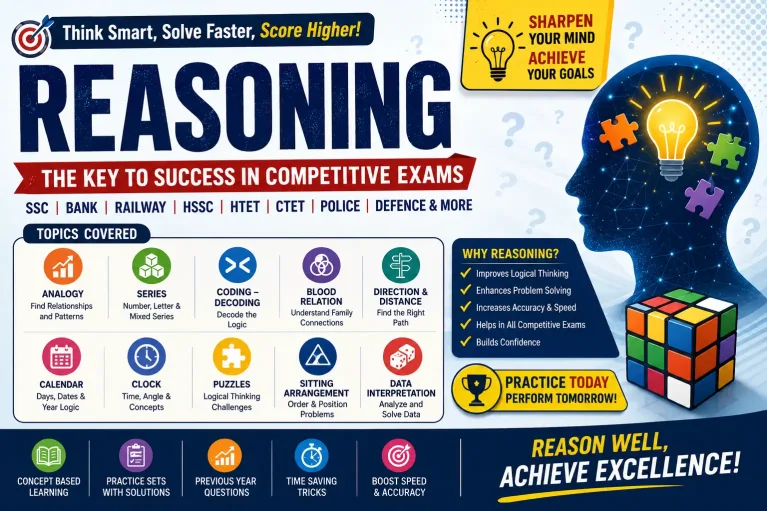
Reasoning- Odd One Out
Odd One Out Reasoning Questions with Answers
Every reasoning paper hides a few marks in plain sight. Odd One Out is one of them. You are handed four or five items — words, numbers, letter pairs, sometimes shapes — and asked to point out the one that does not belong with the rest. No formula. No calculation. Just the ability to notice what everyone else shares.
Examiners love this topic because it takes ten seconds to read and can be solved in fifteen. Students often lose it anyway, because they hunt for the odd item instead of first finding the common thread. That single habit is what this quiz is built to fix.
What Does Odd One Out Mean in Reasoning?
Odd One Out, also called Classification or Odd Man Out, tests whether you can group things by a shared property. Four options follow one rule. The fifth breaks it. Your job is to name the rule silently in your head, then check which option refuses to fit.
Take a simple set: Rose, Lotus, Lily, Mango. Three are flowers, one is a fruit. The answer is Mango.
Now a harder one: 121, 144, 169, 180. The first three are perfect squares — 11², 12², 13². The number 180 is not. Same logic, different dress.
Boards write the topic under different names in their syllabus PDFs. The Haryana Staff Selection Commission lists it as Classification in the CET reasoning section. Banking papers usually call it Odd Man Out. Railway papers sometimes fold it into Analogy and Classification. The question stays the same.
Types of Odd One Out Questions You Will Face
Word Classification
Fruits, flowers, birds, professions, states, capitals, musical instruments. The trap is usually a near-miss — Tomato slipped into a list of vegetables, or Whale placed among fish.
Number Classification
Prime numbers, perfect squares, cubes, multiples, numbers divisible by a common factor. Check divisibility first, then squares, then cubes. That order saves time.
Letter and Alphabet Classification
Groups like BD, FH, JL, MP. Count the gaps between letters. Three pairs skip one letter; one does not.
General Knowledge Based Classification
Rivers, dance forms, freedom fighters, currencies. Reasoning meets GK here, which is why state-level exams use it so freely — a Rajasthan paper may drop four folk dances and one from outside the state.
Non-Verbal Classification
Figures, mirror images, rotated shapes. Common in police, SSC and defence papers. Count sides, count enclosed spaces, check symmetry.
How to Solve Odd One Out Questions Quickly
- Read all options before deciding. The answer is decided by the group, not by any single item.
- Name the common rule out loud in your mind. "All are metals." "All are perfect squares." If you cannot name it, you have not found it yet.
- Test the obvious property first — category, divisibility, spelling pattern, letter gap.
- Move to the second layer if the first fails. Vegetables that grow underground versus above. Even numbers that are also cubes.
- Accept the strongest rule, not the cleverest one. Any set can be twisted to make a second answer look right. Examiners reward the simplest valid grouping.
- Cap your time at 20 seconds. Mark it and return later. A stuck classification question is not worth a solved arithmetic question.
One warning worth repeating: negative marking punishes creativity here. If two answers seem defensible, pick the one a school textbook would agree with.
Which Competitive Exams Ask Odd One Out Questions?
National-Level Exams
Exam Body | Exams |
|---|---|
| SSC | CGL, CHSL, MTS, GD Constable, CPO, Stenographer, Selection Post |
| Railways (RRB) | NTPC, Group D, ALP, JE, RPF Constable & SI |
| Banking & Insurance | IBPS PO, IBPS Clerk, IBPS RRB, SBI PO, SBI Clerk, RBI Assistant, LIC AAO/ADO, NIACL |
| Defence | NDA, CDS, AFCAT, Indian Coast Guard, Agniveer (Army/Navy/Air Force) |
| Teaching & Others | CTET, UGC NET Paper 1, CUET, NRA CET, various PSU exams |
State-Level Exams
- Haryana — HSSC CET (Group C and Group D), Haryana Police Constable and Sub-Inspector, HSSC Clerk and Patwari posts, HTET, HPSC prelims screening tests.
- Rajasthan — RSSB/RSMSSB CET (Graduate and Senior Secondary level), Rajasthan Police Constable, Patwari, Gram Sevak, VDO, Rajasthan Computor, RPSC RAS screening.
- Uttar Pradesh — UPSSSC PET, UP Police Constable and SI, UP Lekhpal, UPPSC prelims, UPSSSC Junior Assistant, UPTET.
- Delhi — DSSSB (PRT, TGT, Junior Assistant, Patwari, Grade IV DASS), Delhi Police Constable and Head Constable, DDA recruitment exams.
- Bihar — BSSC Inter Level and Graduate Level CGL, CSBC Bihar Police Constable, Bihar Daroga (SI), Bihar Excise Constable, BPSC screening papers.
- Jharkhand — JSSC CGL (JGGLCCE), JSSC Excise Constable, JSSC Panchayat Secretary, Jharkhand Police Constable, JPSC prelims.
- Himachal Pradesh — HP Rajya Chayan Aayog (the body that replaced the disbanded HPSSC Hamirpur) exams such as JOA-IT and Clerk, HP Police Constable, HPPSC HPAS prelims.
- Chandigarh — Chandigarh Police Constable, UT Chandigarh Group C posts, Chandigarh JBT and clerk recruitment.
- Punjab — PSSSB Clerk, VDO and Excise Inspector, Punjab Police Constable and SI, PPSC prelims, Punjab Patwari.
- Also useful for — Madhya Pradesh (MPPEB/ESB), Uttarakhand (UKSSSC), Chhattisgarh (CGPSC/Vyapam), Maharashtra (MPSC), Gujarat (GPSSB) and most other state subordinate service boards.
Anyone preparing for a state CET gets extra value here. Because CET papers keep no negative marking in several states and run on a tight clock, fast topics like classification decide the cut-off more than hard topics do.
Why Practise Odd One Out on This Quiz
- Questions are arranged from easy to exam-level, so beginners are not thrown into the deep end.
- Every answer carries a one-line reason, not just a letter.
- Word, number, letter and GK-based sets are mixed, exactly as real papers do it.
- Attempt it as many times as you like. No sign-up wall.
- Works on a phone, which matters when your practice happens on a bus or between classes.
A Quick Self-Check Before You Start
Try these three. Answers sit at the end of the quiz.
- Copper, Iron, Mercury, Zinc
- 27, 64, 100, 125
- Chandigarh, Shimla, Jaipur, Kanpur
If you spotted why Mercury, 100 and Kanpur stand apart, you are ready for the timed set below.
Summary
Odd One Out rewards pattern recognition, not memorisation. Find the rule that binds the majority, and the exception announces itself. Practise mixed sets daily for two weeks, keep a note of every question you got wrong, and this becomes one of the fastest-scoring areas in your reasoning section — whether you sit for SSC CGL in Delhi, CET in Haryana or Rajasthan, PET in Uttar Pradesh, or a constable paper in Bihar, Punjab or Himachal.
Other Important Links:
- Psychology Practice Set
- Haryana GK Practice Set
- Hindi Grammar Practice Set
- English Grammar Practice Set
- Reasoning Practice Set
- Mathematics Practice Set
Your Progress
0%Frequently Asked Questions

Written by Deepak
Educational Content Creator
I am an educational content creator dedicated to making learning simple, engaging, and accessible for students preparing for competitive exams. He specializes in creating high-quality study materials, including notes, multiple-choice questions (MCQs), previous year question papers, practice tests, and exam-oriented resources.
Experience: 10+ years in Education and Competitive Exam Content Creator